
Cracked crown or crumbling brick in Binghamton, NY
You have looked up and seen it. The concrete slab on top of the chimney is split, or there are gaps where mortar used to be, or you are finding chips and chunks of brick on the roof, in the gutter or on the ground. That slab is the crown. It is supposed to shed water off the top of the stack and away from the brick. Once it cracks, water gets in behind it and starts working on everything underneath.
Phones answered around the clock · free estimate
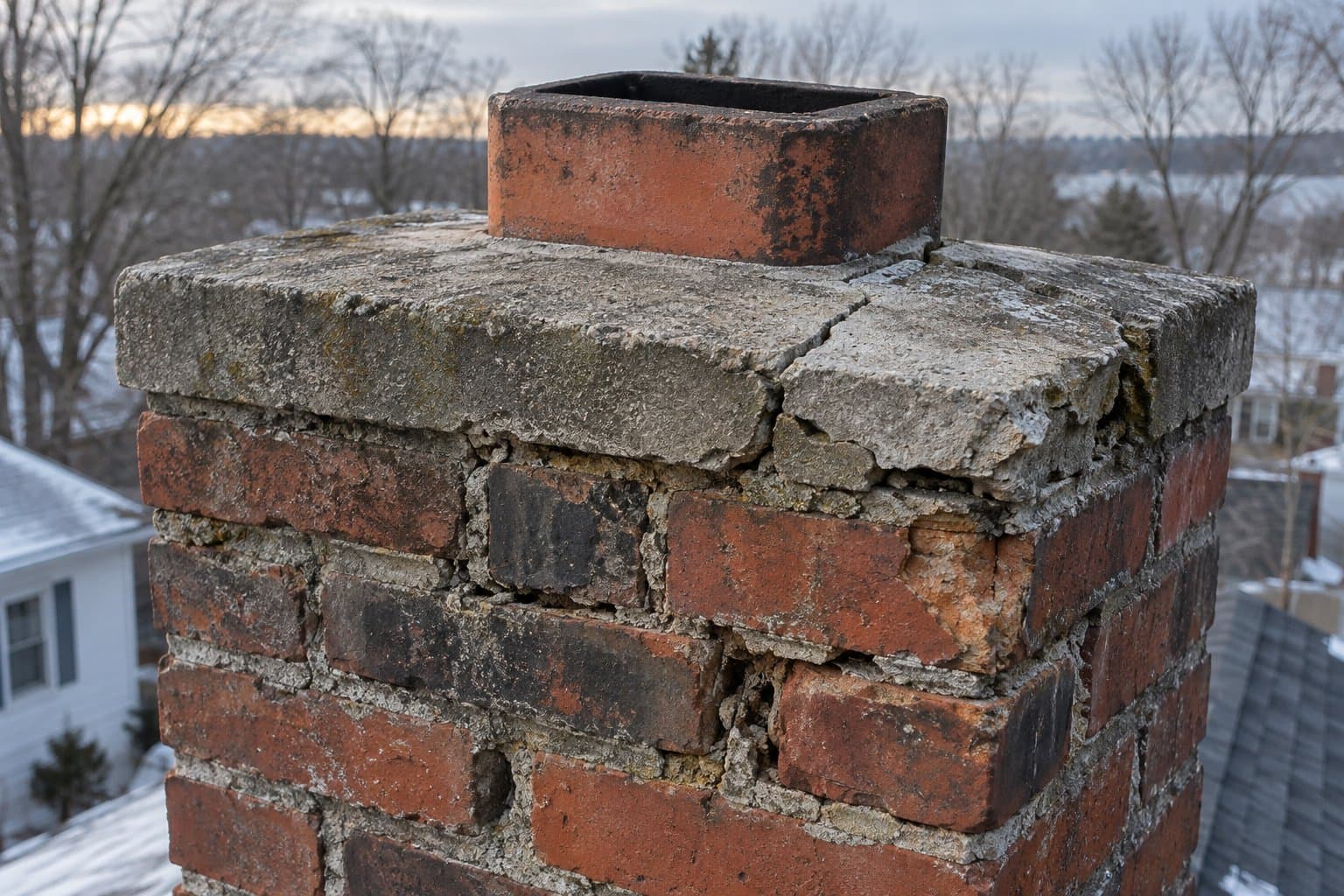
This happens fast in Binghamton. The climate here is cold and snowy in winter and damp and cloudy much of the year, so masonry soaks up water and then freezes. Repeated freeze-thaw cycles are the main threat to chimneys in this area, and road salt does not help. Water expands as it freezes, the crack widens, more water gets in, and a hairline crack turns into spalled brick and a loose stack. Much of Binghamton's housing predates 1940, so a lot of these are original masonry chimneys that have been through a great many winters.
While you wait — please don't
- Keep people away from the base of the chimney. Falling brick is a real hazard at ground level, so move cars, trash cans and anything the kids use away from that side of the house until it has been looked at.
- Stop using the fireplace or stove if debris has fallen inside. Crown or brick fragments can drop down the flue and block it, and a blocked flue can push smoke and carbon monoxide back into the house.
- Get out and call 911 if anyone feels ill or a CO alarm sounds. Headache, dizziness or nausea around a working fireplace or furnace flue means everyone goes outside first and calls from there.
- Treat a leaning stack as structural, not cosmetic. A chimney that is tilting or has open gaps has lost structure, and sealant or patching over the top will not hold it together.
- Stay off the roof. Loose brick, wet moss and winter ice make the area around a failing stack a bad place to be standing.
What the technician does
- The chimney gets inspected firstThe technician looks at the crown, the brick, the mortar joints and the flue above and below the roofline to work out whether this is a repair or a rebuild. You get the price before any work starts, and you approve it first.
- The crown is repaired or recastA proper crown is formed with an overhang and a drip edge so rainwater falls clear of the brick instead of running down the face of the stack. Recasting is common when the old crown is cracked through rather than just surface-chipped.
- Open joints are repointedFailed mortar is cut out and replaced with new mortar matched to the existing work, which matters on older Binghamton chimneys where the original brick and joints are soft.
- Spalled brick is cut out and replacedWhere the face has popped off the brick, those units are removed and new ones set in. Spalling is the usual end result of water freezing inside the masonry.
- A cap is fittedA cap over the flue keeps rain, snow and animals out of the chimney, which slows down the same water damage starting over again.
- The stack is rebuilt above the roofline if neededWhen the top section has lost structure, leans or has open gaps, the masonry above the roof is taken down and rebuilt rather than patched.
Why this happens in Binghamton, NY
Binghamton sits at the confluence of the Susquehanna and Chenango, and the weather here is among the dampest and cloudiest in the country. Masonry rarely gets a chance to dry out. Add a long heating season running roughly October through April, and chimneys here work hard and stay wet. That combination is why crowns crack and brick spalls on the North Side, West Side, First Ward and up the hillside streets on the East Side, and in Hillcrest, Port Dickinson and Chenango Bridge just the same.
The housing stock matters too. Wood-frame Victorians, foursquares and two-family homes with full basements and original masonry chimneys are everywhere in Binghamton, and many of those chimneys were built for coal or oil heat and later lined for gas. That means a chimney you never light a fire in may still be an active venting flue. Timing-wise, exterior masonry work concentrates in the warmer months when mortar can cure without freezing, and demand climbs in late summer and fall as people get ready for winter, with a second wave in the spring thaw when the winter's freeze damage shows itself. If you are seeing crown cracks now, it is worth getting it looked at rather than waiting for another freeze cycle. We arrange the same work in Johnson City, Endicott, Vestal and Endwell.
Questions people ask
- Do I need a permit for chimney masonry work in Binghamton?
- In New York, permits are issued locally by the municipal building department and code enforcement officer, not by a state agency. Structural masonry work such as rebuilding a chimney above the roofline typically requires one, while routine sweeping and inspection generally does not. Call the local building department before work begins, since thresholds vary between jurisdictions.
- Is there a New York state license for chimney masonry?
- New York does not issue a statewide contractor license for chimney sweeping, inspection or masonry repair. It is handled at the city or county level, and many upstate municipalities require only local registration or nothing at all. You can verify current requirements with the city or county consumer affairs or licensing office.
- Can my crown be repaired, or does the whole chimney need rebuilding?
- That depends on how far the water has got into the stack and whether the brickwork below has lost structure. The technician inspects it and tells you which it is before any work starts. Ask for the reasoning in writing, and ask to see any photos or camera footage taken on the roof.
- The chimney only vents my furnace now. Does a cracked crown still matter?
- Yes. Plenty of Binghamton chimneys were built for coal or oil and later lined for gas, so they are still carrying combustion gases out of the house. Falling masonry can block that flue, and a blocked flue is a carbon monoxide problem.
- What time of year is best for this work in Binghamton?
- Exterior masonry and repointing concentrate in the warmer months, because mortar needs to cure without freezing. Demand across the area peaks in late summer and fall ahead of the heating season, and again in the spring thaw when freeze damage surfaces.
One call
One Call Chimney is a referral and scheduling service, so one call to (866) 576-7943 gets the job arranged with an independent sweep or mason in the Binghamton area. The estimate is free, the technician inspects the chimney and gives you the price first, and nothing starts until you approve it.
More from One Call Chimney
Nearby
Answers
Free tool
Something else in this area
- Rebuild or new chimney
- Smoke comes back into the room
- Never been swept
- Water coming in
- Something living up there
- Smells of smoke or damp
- Damper stuck or broken
- Liner damaged or missing
One Call Chimney arranges the visit; the technician does the work and gives you the price.