
Cracked crown or crumbling brick in Rochester, NY
You have looked up and seen cracks across the top of the chimney, or you have found chips of brick in the yard, in the gutter, or on the roof. The crown is the concrete slab that caps the masonry and sheds water away from the flue. Once it cracks, water gets into the brick and mortar underneath. The brick face then flakes off in layers. That is spalling, and it does not stop on its own.
Phones answered around the clock · free estimate
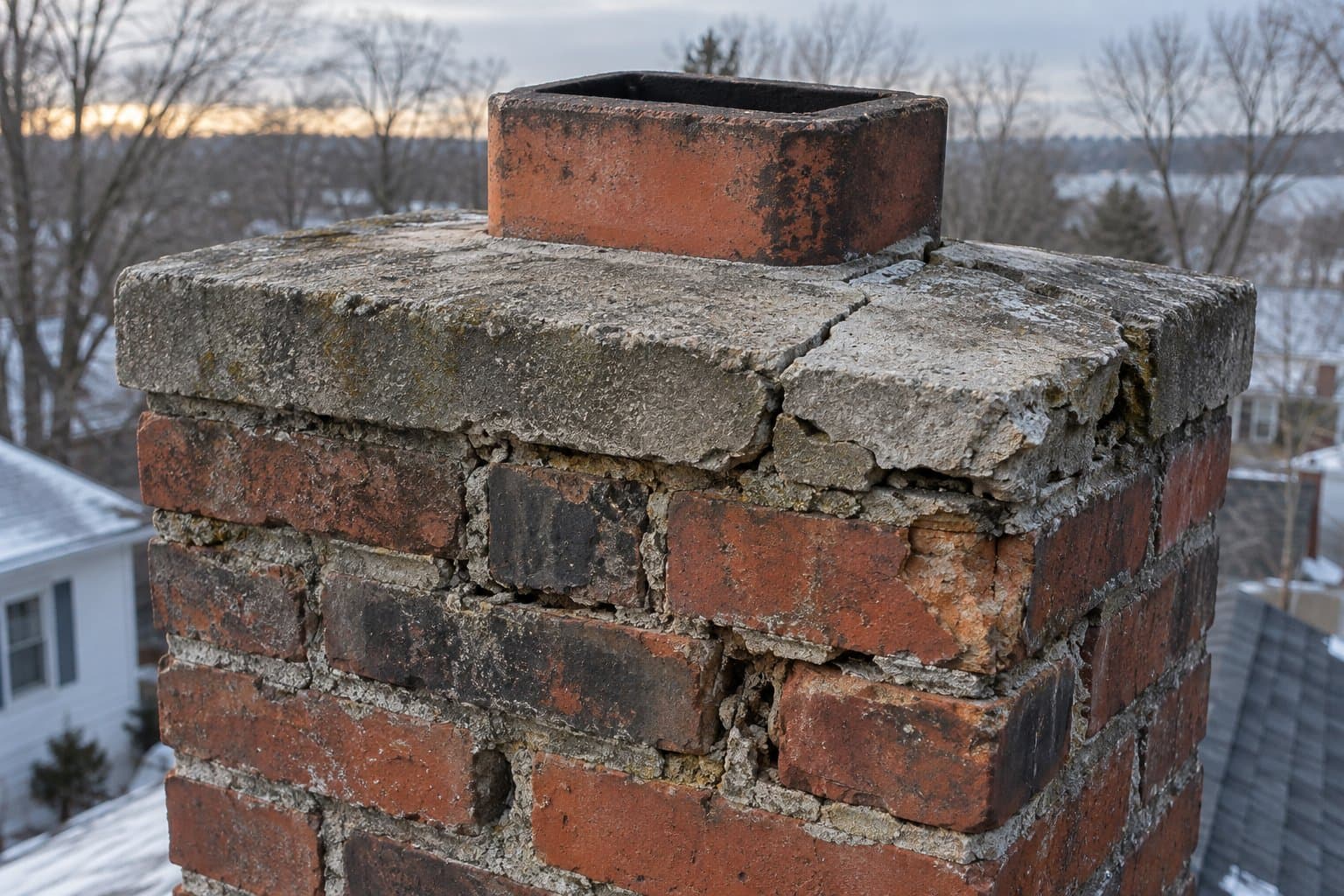
Rochester makes this happen faster than most places. The city sits just south of Lake Ontario, so winters bring heavy lake-effect snow and long stretches below freezing. Water soaks into a cracked crown or an open mortar joint, freezes, expands, and thaws again. Each cycle opens the gap a little wider. Add in the fact that much of Rochester's housing stock predates 1940 — Victorians, foursquares, colonials and bungalows, many with their original masonry chimneys — and you have old brick taking that beating winter after winter.
While you wait — please don't
- Keep people away from the base of the chimney. Falling brick is a real hazard at ground level, so move cars, bins and anything children or pets use out from under the stack until someone has looked at it.
- Do not use the fireplace if the stack is leaning or has open gaps. A leaning chimney or one with gaps you can see through is a structural problem, not a cosmetic one, and the flue may no longer be safely containing smoke and heat.
- Stop the fire if smoke enters the house. If smoke comes into the room while you are burning, let the fire go out, open a window, and do not light it again until the chimney has been inspected.
- Treat a carbon monoxide alarm as an emergency. If your CO alarm sounds, or anyone feels dizzy, sick or has a headache, get everyone outside first and then call 911.
- Do not climb up to patch it yourself. Smearing sealant over a cracked crown traps water in the masonry and hides how far the damage has already gone.
What the technician does
- A look at the whole stack, not just the crackThe technician inspects the crown, the mortar joints, the brick faces and the section above the roofline to work out how deep the water damage goes. The price is given to you before any work begins.
- Crown repaired or recastA damaged crown can be repaired, or cut off and recast properly with an overhang and a drip edge so rain is thrown clear of the brickwork instead of running down it.
- Repointing matched to the existing workOpen and eroded mortar joints are raked out and refilled. On older Rochester brick, the new mortar is matched to what is already there.
- Spalled brick cut out and replacedBricks that have lost their face are cut out individually and replaced. Leaving them in place means the water keeps travelling into the courses behind them.
- A cap fittedA cap over the flue keeps rain and snow out of the chimney, which is the main thing that stops the same freeze-thaw damage starting again next winter.
- Rebuild above the roofline where neededIf the stack has lost structure and repointing will not hold it, the masonry above the roofline is taken down and rebuilt.
Why this happens in Rochester, NY
Freeze and thaw is what turns a hairline crack into a rebuild, and Rochester gets plenty of both. The long cold stretches and the snow coming off Lake Ontario keep masonry wet, then frozen, then wet again. Humid summers do not help either — an unused flue stays damp, and that moisture works on the brick from the inside. Chimneys on pre-war homes around Park Avenue, Corn Hill, the South Wedge, Maplewood and the 19th Ward are often the original masonry, with older or undersized flues, so crown and brick problems here tend to come with liner questions attached.
Timing matters with this kind of work. Across New York, exterior masonry rebuilding and repointing concentrate in the warmer months, because mortar needs to cure without freezing. If you spot a cracked crown in the fall, it is worth getting it looked at before the first hard freeze rather than waiting until February. The same goes for Brighton, Irondequoit, Greece, Penfield, Webster, Pittsford, Henrietta and Fairport — the weather off the lake does not stop at the city line.
Questions people ask
- Is a cracked crown urgent, or can it wait?
- Small cracks are not an emergency, but they get worse every freeze-thaw cycle, and Rochester has a lot of those. Falling brick at ground level and any leaning in the stack are the signs to act on straight away.
- Do I need a permit for chimney masonry work in Rochester?
- In New York, permits are issued locally by the municipal or county building department, not by a state agency. Structural masonry work such as rebuilding a chimney above the roofline typically needs one, while routine sweeping and inspection generally do not. Call your local building department before work begins.
- Is there a state license for chimney masons in New York?
- New York does not issue a statewide license for chimney sweeping, inspection or masonry repair. It is handled locally, and many upstate municipalities require only local registration. Check current requirements with the city or county consumer affairs or licensing office covering your address.
- Can the crown be patched instead of recast?
- Sometimes, depending on how far the cracking goes and whether water has already reached the brick below. The technician will tell you which applies to your chimney and why. Ask for the reasoning in writing, and ask to see any photos taken on the roof.
- What does One Call Chimney actually do?
- We are a referral and scheduling service that arranges chimney work with independent sweeps and masons across all fifty states. We are not the contractor and we do not perform the work ourselves. We set up the visit, and the independent technician handles the inspection and the repair.
One call
Call (866) 576-7943 and we will arrange for an independent mason to come out and look at your chimney in Rochester. Every job starts with a free estimate — the technician inspects the chimney and gives you the price before any work starts, and you approve it first.
Something else in this area
- Water coming in
- Something living up there
- Smoke comes back into the room
- Smells of smoke or damp
- Liner damaged or missing
- Never been swept
- Rebuild or new chimney
- Damper stuck or broken
One Call Chimney arranges the visit; the technician does the work and gives you the price.