Stop using the fireplace
Liner damaged in Binghamton, NY
Someone has looked up your flue and told you the liner is cracked. That usually means the clay tiles inside the chimney have split, slipped or lost mortar between them, or that a metal liner has corroded through. The liner is the part that keeps heat and combustion gases inside the chimney and away from the wood framing of your house. Once it is broken, the chimney is no longer doing that job.
Phones answered around the clock · free estimate
This is common in Binghamton. Much of the housing stock here predates 1940 — wood-frame Victorians, foursquares and two-family homes with full basements and original masonry chimneys. Many of those chimneys were built for coal or oil heat and later lined for gas, and across New York unlined or clay-tile masonry chimneys needing relining are very common. Add a long heating season from October through April, plus repeated freeze-thaw cycles and some of the dampest weather in the country, and a flue that has absorbed moisture will crack its tiles and lose mortar joints faster than one in a dry climate.
While you wait — please don't
- Stop using the fireplace or stove. A damaged liner lets heat and carbon monoxide reach the structure of the house, so the appliance should not be used again until the flue has been inspected and verified.
- If anyone feels sick, get out and call 911. Headache, dizziness, nausea or a sleepy, confused feeling in more than one person can mean carbon monoxide — leave the house, take everyone with you, and call 911 from outside.
- Do not light a fire after a chimney fire. Clay tiles crack in a chimney fire, so after any chimney fire the flue must be inspected before it is used again, even if the chimney looks fine from the street.
- Do not switch the appliance to gas and leave the old flue alone. Converting to gas without relining leaves acidic condensate attacking the masonry from the inside.
- Do not patch it from the fireplace opening. You cannot see or reach the damaged section from below, and a sealant smeared over a cracked tile does not restore the liner.
What the technician does
- Camera inspection firstThe technician runs a camera up the full length of the flue before quoting anything, so the damage is seen rather than guessed at. Ask to watch the footage with them and ask them to point out each crack or open joint.
- The appliance and the flue get matchedThe liner has to suit what it is venting — size, material and termination all have to match the appliance. A wood stove, an open fireplace and an atmospheric gas furnace each need something different.
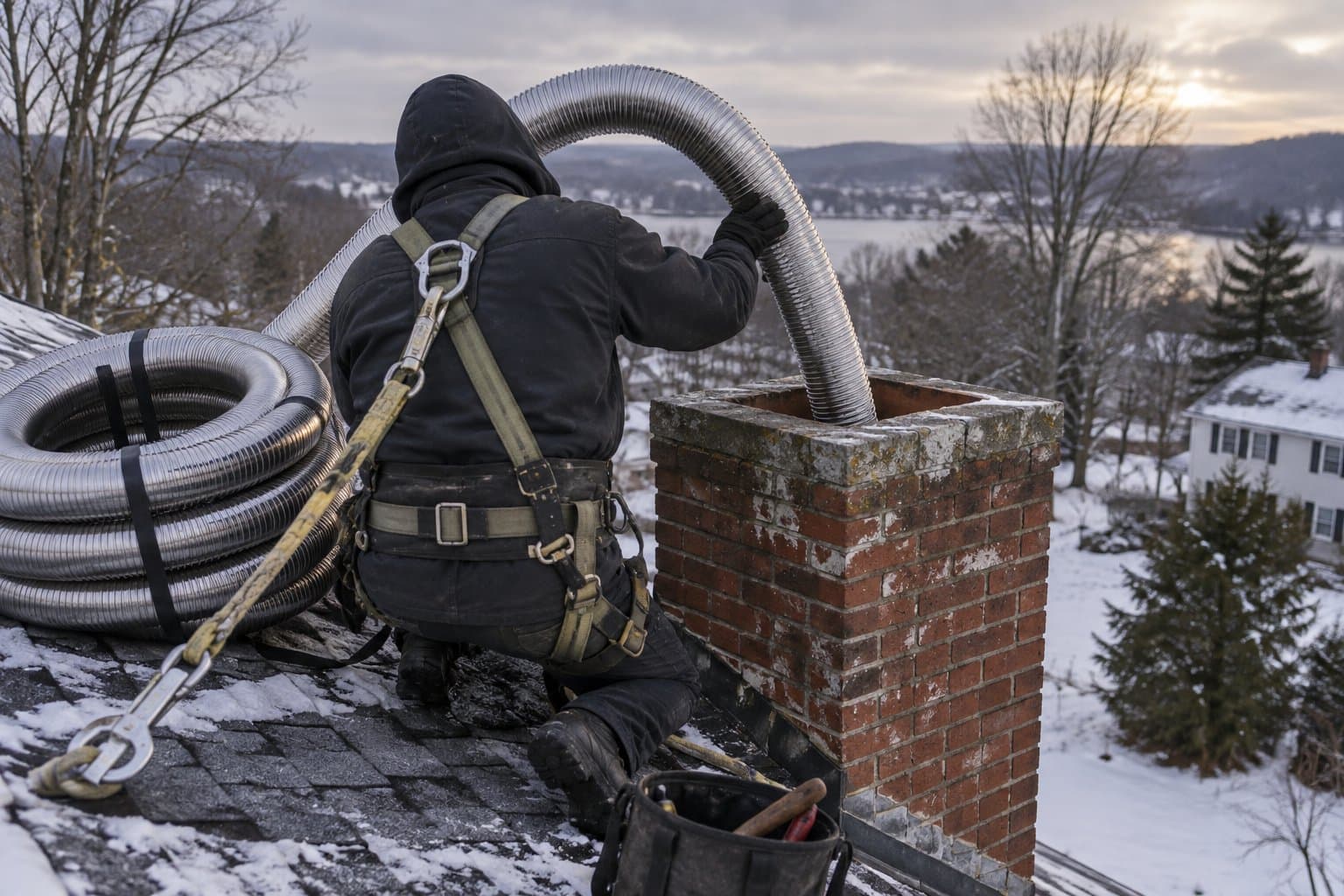
- Stainless steel liner, sized and insulatedThe usual repair is a stainless steel liner sized to the appliance and insulated where that is required. Insulation helps the flue stay warm, which matters on a long Binghamton heating season.
- Cast-in-place lining where it suitsOn some chimneys a cast-in-place lining is the better answer. The technician explains which route they are recommending and why, and you can ask for that reasoning in writing.
- Cap and crown addressed at the same timeThere is no point putting a new liner into a chimney that is still taking on water at the top, so the cap and crown are dealt with as part of the same job.
- You get the price before work startsThe technician inspects the chimney and gives you the price, and you approve it before anything begins.
Why this happens in Binghamton, NY
Freeze-thaw is the main enemy here. Water gets into a crown or a mortar joint, freezes, expands and opens the gap a little wider, and Binghamton goes through that cycle over and over through a cold, snowy winter. The damp, cloudy weather means a flue often does not get a chance to dry out between rounds. That is why crowns crack and why a flue that has absorbed moisture ends up with split tiles.
The older neighbourhoods — West Side, East Side, North Side, First Ward, South Side — are full of houses with original masonry chimneys still working as active venting flues rather than decoration. Work tends to get booked in late summer and fall, when people are getting ready for the heating season, and again mid-winter when draft and odour problems show up. Exterior masonry and repointing concentrate in the warmer months, when mortar can cure without freezing, so if the crown needs work too, timing is worth discussing with the technician.
Questions people ask
- Can I use the fireplace until the liner is fixed?
- No. A damaged liner lets heat and carbon monoxide reach the structure of the house, and the appliance should not be used until the flue is verified. Keep your carbon monoxide alarms working in the meantime.
- Do I need a permit in Binghamton?
- In New York, permits for chimney work are issued locally by the municipal or county building department and code enforcement officer, not by a state agency. Relining as part of an appliance installation typically needs one, while routine sweeping and inspection generally do not. Call the local building department before work begins, since requirements vary between jurisdictions.
- Is there a state chimney licence I should ask about?
- New York does not issue a statewide licence for chimney sweeping, inspection or masonry repair — it is handled locally. Many upstate municipalities require only local registration or nothing at all, so check current requirements with the city or county consumer affairs or licensing office where the work will be done.
- What code does the work get judged against?
- New York enforces the Uniform Fire Prevention and Building Code, based on the International Code family with state amendments. Solid-fuel appliance and chimney installations are also commonly evaluated against NFPA 211 and the appliance manufacturer's listed instructions.
- My furnace was converted to gas years ago. Does that matter?
- It can. Plenty of Binghamton chimneys were built for coal or oil and later lined for gas, and converting to gas without relining leaves acidic condensate attacking the masonry. A camera inspection will show what shape the flue is in.
- Who actually comes out?
- One Call Chimney is a referral and scheduling service that arranges the work with independent sweeps and masons. We are not the contractor and we do not perform the work ourselves.
One call
Call (866) 576-7943 and we will arrange a chimney technician to come out and inspect the flue in Binghamton. The estimate is free, and you approve the price before any work starts.
More from One Call Chimney
Something else in this area
- Rebuild or new chimney
- Smoke comes back into the room
- Never been swept
- Water coming in
- Something living up there
- Smells of smoke or damp
- Damper stuck or broken
- Cracked crown or crumbling brick
One Call Chimney arranges the visit; the technician does the work and gives you the price.