
Cracked crown or crumbling brick in Utica, NY
You have looked up and seen it. The flat concrete top of the chimney is split, or chunks of brick face are flaking off and landing in the yard. That slab on top is the crown. Its job is to shed water away from the brick and the flue. Once it cracks, water runs straight into the masonry instead of off it.
Phones answered around the clock · free estimate
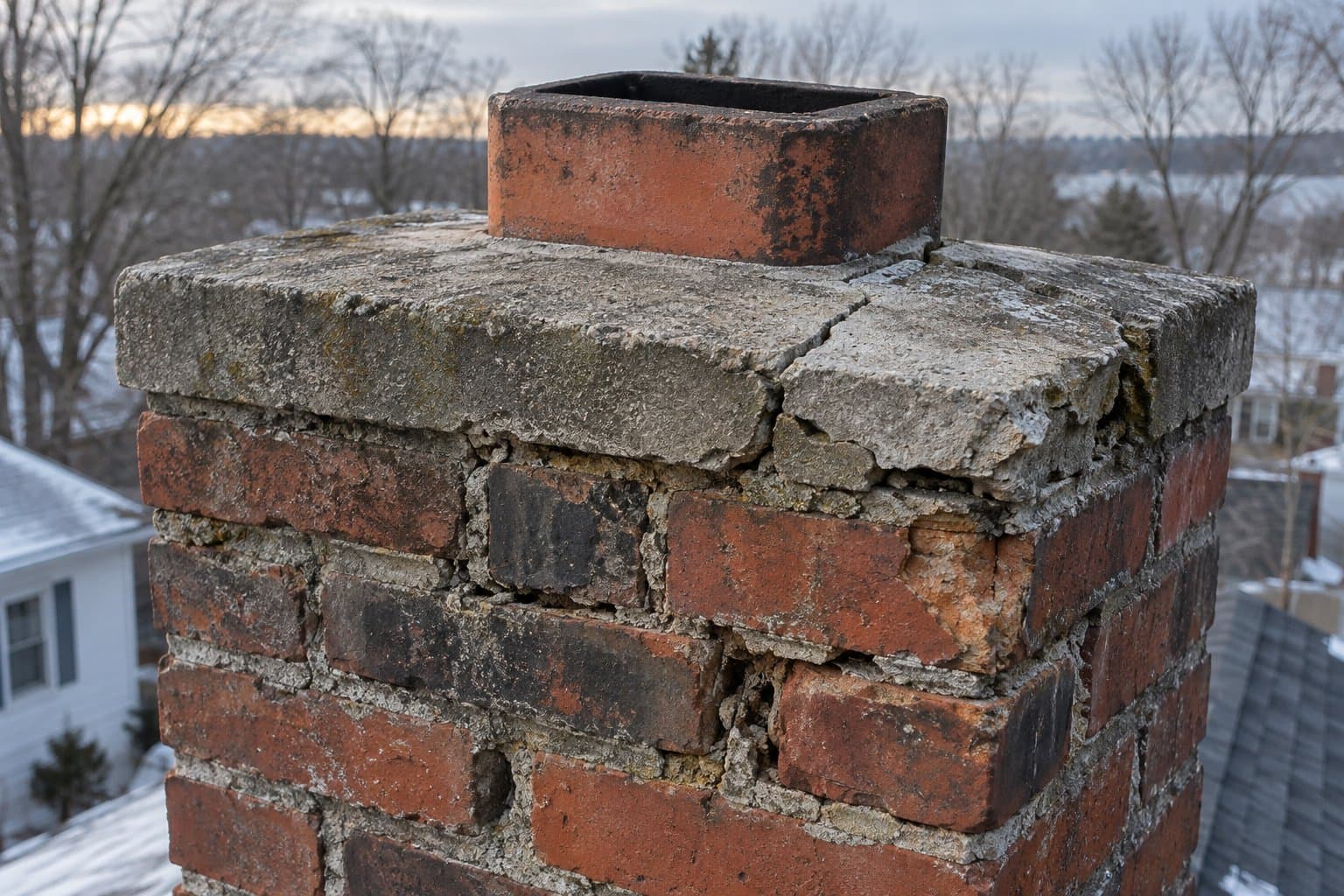
In Utica that water does the real damage. It soaks into mortar joints and brick, then freezes on one of the many sub-zero nights here and expands. Repeat that through a long winter of freeze-thaw cycles and lake-effect snow, and a hairline crack becomes crumbling joints, spalled brick faces and, eventually, a stack that has lost structure. Most of the city's housing predates 1940, so a lot of these are original masonry chimneys that have been through a great many of those winters.
While you wait — please don't
- Keep people away from the base. Falling brick is a real hazard at ground level, so move cars, bins and anything you walk past daily out from under the chimney.
- Do not climb up to look. A chimney that is shedding brick may have soft, unstable masonry at the top, and a snowy or iced roof in Utica is no place to find that out.
- Stop using the fireplace if the stack leans or has open gaps. A leaning stack or one with holes through the masonry is a structural problem, not a cosmetic one, and the flue inside may no longer be contained.
- Do not smear sealant over the cracks and call it done. Patching the surface traps water inside the crown and the brick below, and the next freeze pushes the damage further open.
What the technician does
- The technician looks at the whole stackNot just the crack you can see. They check the crown, the mortar joints, the brick faces, the cap and the section above the roofline for movement or loss of structure.
- The crown is repaired or recastA proper crown is formed with an overhang and a drip edge so water falls clear of the brick instead of running down the face of it. Where the existing crown is too far gone to patch, it gets recast.
- Joints are repointed to matchOpen and washed-out mortar joints are cut back and repointed, with the new work matched to the existing masonry so the repair is not an eyesore on an older Utica home.
- Spalled brick is cut out and replacedBrick whose face has popped off will keep absorbing water. Those units are cut out and replaced rather than skimmed over.
- A cap is fittedA cap keeps rain and snow out of the flue itself, which is the other half of keeping the masonry dry.
- Rebuild above the roofline where neededIf the stack has lost enough structure that repointing will not hold it, the section above the roof is taken down and rebuilt.
Why this happens in Utica, NY
Utica's winters are long and the freeze-thaw cycling is relentless. Water that sits in a cracked crown or an open joint freezes, expands, and widens the gap a little more each time. That is why cold regions lose stacks faster than mild ones, and why a crack that looked minor last fall can look alarming by the spring thaw. Heavy seasonal snow, including lake-effect bands off Lake Ontario, adds load and meltwater right at the roofline where the flashing meets the brick.
The housing here matters too. Utica is dominated by pre-1940 wood-frame and brick homes — Victorians, foursquares and two-family doubles — and most still have their original masonry chimneys. Many of those were built for coal or early oil heat and are now venting modern furnaces, so crown and masonry work often turns up relining questions at the same time. Demand climbs in early fall as people prep before the snow, and again in late winter and spring when thaw damage surfaces. Exterior masonry work also concentrates in the warmer months, because mortar needs to cure without freezing.
Questions people ask
- Can the crown be repaired in winter here?
- An inspection can happen any time, but fresh mortar and crown material need to cure without freezing. In Utica that usually means exterior masonry is scheduled for warmer weather, and the technician will tell you what is workable when they look at it.
- Is this cosmetic or do I need to deal with it now?
- Falling brick at ground level is a hazard on its own. A leaning stack, or one with open gaps through the masonry, is structural rather than cosmetic and should be looked at before another freeze-thaw season works on it.
- Do I need a permit in Utica?
- In New York, permits are issued locally by the municipal or county building department, not by a state agency. Structural masonry work such as rebuilding a chimney above the roofline typically requires one, while routine inspection generally does not. Call your local building department before work begins.
- My chimney is from the 1920s. Does that change the repair?
- Often yes. So much of Utica predates World War II that chimneys built for coal and early oil heat are still in service behind modern furnaces, and crown or masonry work on those frequently raises relining and crown questions together. The technician will tell you what they find and why.
- What should I ask the technician?
- Ask them to show you the photos or camera footage of the crown and the joints, and ask for their reasoning in writing. You should understand why they recommend repointing versus a rebuild before you agree to anything.
- Who actually does the work?
- One Call Chimney is a referral and scheduling service. We arrange the job with independent sweeps and masons; we are not the contractor and we do not perform the work ourselves.
One call
Call (866) 576-7943 and we will arrange for a technician to inspect your chimney in Utica, with a free estimate on every job. They give you the price before any work starts, and nothing happens until you approve it.
More from One Call Chimney
Nearby
Answers
Free tool
Something else in this area
- Smoke comes back into the room
- Never been swept
- Rebuild or new chimney
- Water coming in
- Something living up there
- Smells of smoke or damp
- Damper stuck or broken
- Liner damaged or missing
One Call Chimney arranges the visit; the technician does the work and gives you the price.