
Cracked crown or crumbling brick in Syracuse, NY
You have looked up at the chimney and seen cracks across the top, or you are finding chips and chunks of brick in the gutter, on the roof, or in the yard. The crown is the slab at the very top of the stack. Its job is to shed water away from the brick and the flue. Once it cracks, water gets in, sits in the masonry, and starts working the joints and brick faces apart from the inside. The flaking brick faces you are seeing are called spalling, and they mean water has already been in there for a while.
Phones answered around the clock · free estimate
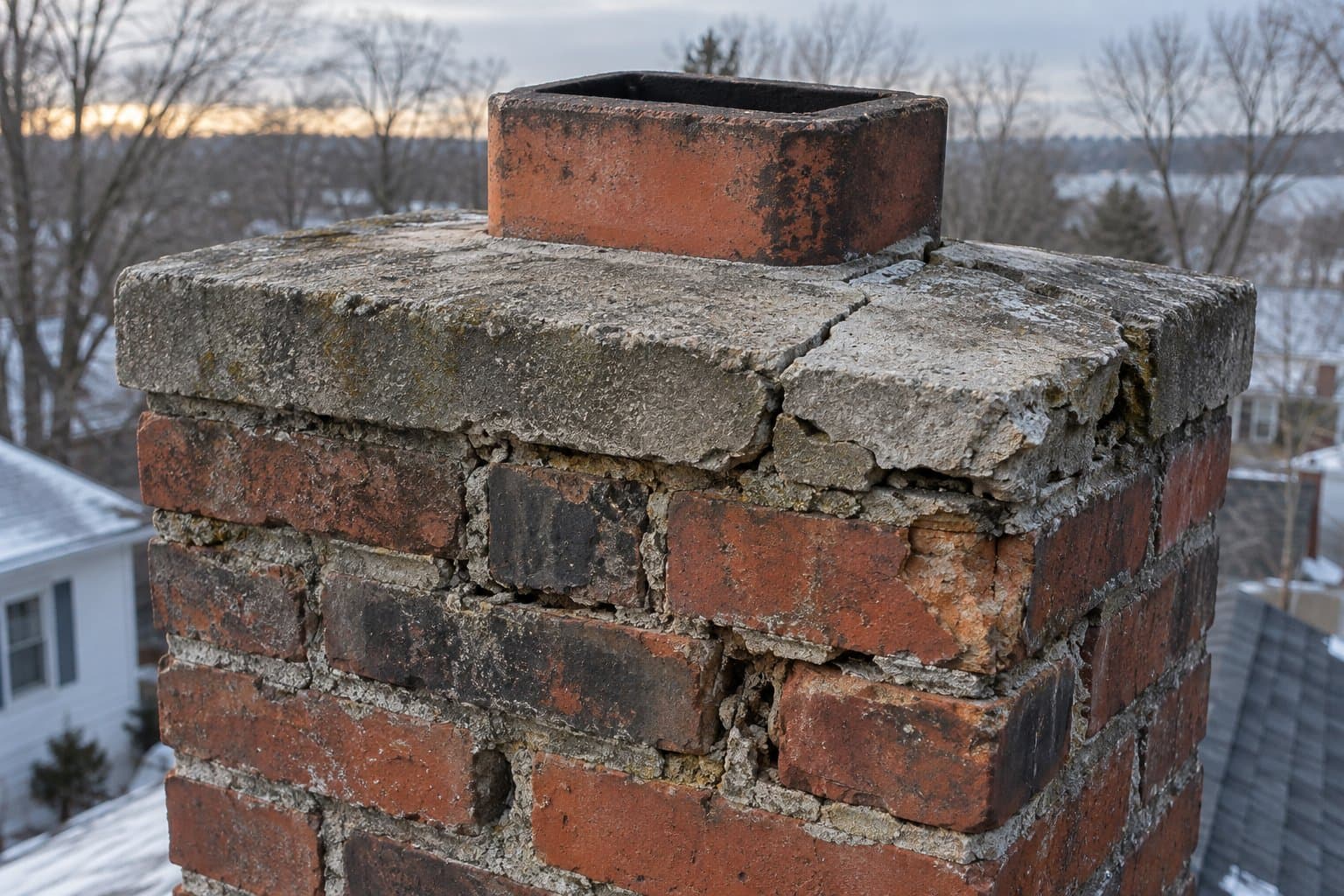
This happens fast in Syracuse. Winters here are cold and very snowy, with lake-effect snow off Lake Ontario, and the freeze-thaw cycling that comes with it is the single hardest thing on a masonry chimney. Water soaks into a hairline crack, freezes, expands, and makes the crack bigger. Repeat that through a heating season that runs roughly October through April and a hairline crack becomes a rebuild. Much of Syracuse's housing stock was built before 1940, and century-old brick chimneys around the city commonly show exactly this: mortar loss, spalling and crowns that have given up.
While you wait — please don't
- Keep people away from the base of the chimney. Falling brick from roof height is a real hazard at ground level, so move cars, bins and anything you use daily out from under the stack.
- Stop using the fireplace if the stack leans or has open gaps. A leaning chimney or one with open holes in the masonry is a structural problem, not a cosmetic one, and combustion gases can escape where the brickwork has opened up.
- Treat a carbon monoxide alarm as an emergency. If your CO alarm sounds, or people in the house feel dizzy, sick or headachy while the fire or furnace is running, get everyone outside and call 911.
- Do not go up on the roof to look. Older Syracuse homes tend to have steep pitched roofs, and with snow, ice or loose brick underfoot that is not a climb worth making.
What the technician does
- The chimney gets looked at firstThe technician inspects the crown, the joints, the brick faces and the stack above the roofline to work out how far the damage goes. You get the price before any work starts, and you approve it first.
- The crown is repaired or recastDepending on how bad it is, the crown gets patched or fully recast. A proper crown is built with an overhang and a drip edge so water is thrown clear of the brick instead of running down it.
- Open joints are repointedWhere mortar has washed out or crumbled, the joints are cut back and repointed. The work is matched to the existing masonry so it does not read as a patch on an older Syracuse chimney.
- Spalled brick is cut out and replacedBrick with the face flaked off will not stop deteriorating on its own. Those units are cut out and replaced so the stack keeps its structure.
- A cap is fittedA cap over the flue keeps rain, snow and animals out of the chimney. It is the cheapest way to stop the whole cycle starting again, and it is usually done alongside crown work.
- Rebuild above the roofline where neededIf the stack has lost too much structure to save, the section above the roofline is taken down and rebuilt. That decision should come with reasoning, and you can ask for it in writing.
Why this happens in Syracuse, NY
Syracuse gets hit harder than most places. It is among the snowiest large cities in the country, and the snow, ice and repeated freezing and thawing are the dominant stressors on masonry chimneys here. Add a long heating season that keeps the flue in near-constant use, and warm humid summers that leave an unused flue damp, and the brick never really gets a break. The older wards and neighborhoods — Eastwood, Westcott, Tipperary Hill, Strathmore, Salt Springs, the Valley — are full of pre-1940 wood-frame houses with brick and stone masonry chimneys that were built before anyone was thinking about eighty more winters of lake-effect weather.
Timing matters with this particular job. Exterior masonry work concentrates in the warmer months across New York, because mortar needs to cure without freezing. Two busy stretches show up here: early fall, September through November, when people are getting the chimney ready before the snow, and the spring thaw, when winter damage becomes obvious. If you are seeing cracks and loose brick now, it is worth getting eyes on it rather than waiting to see what another Syracuse winter does to it. We arrange work in Syracuse and the surrounding towns — DeWitt, Liverpool, Camillus, Baldwinsville, Manlius, Fayetteville, North Syracuse and Solvay.
Questions people ask
- Do I need a permit for chimney masonry work in Syracuse?
- Permits in New York are issued locally, not by a state agency. Structural masonry work such as rebuilding a chimney above the roofline typically requires one, while routine sweeping and inspection generally do not. Call the Syracuse building department before work begins, since thresholds vary between jurisdictions.
- Is there a state chimney license I should ask about?
- New York does not issue a statewide license for chimney sweeping, inspection or masonry repair. It is handled at the city or county level, and many upstate municipalities require only local registration or nothing at all. You can verify current requirements with the city or county consumer affairs office where the work will be done.
- Can the crown just be patched, or does the whole thing need rebuilding?
- It depends on how far the damage has traveled. A cracked crown on an otherwise sound stack can often be recast, but if joints are washed out, brick faces are spalling and the stack has lost structure, a rebuild above the roofline is the honest answer. Ask the technician to explain the reasoning in writing.
- Will fixing the crown stop water getting into my house?
- Often, yes, because a cracked crown is one of the common ways water enters a chimney. A recast crown with an overhang and drip edge, sound repointing and a cap together keep rain and melting snow out of the masonry. If water is still showing up inside, that gets investigated as its own problem.
- Why does this keep happening to older Syracuse chimneys?
- Freeze and thaw is what turns a hairline crack into a rebuild, and cold, snowy regions lose stacks faster. Syracuse's large share of pre-1940 housing means a lot of very old brick has been through a lot of winters. Keeping the crown sound and a cap in place is what slows the cycle down.
One call
One Call Chimney is a referral and scheduling service — we arrange the work with independent sweeps and masons, and we are not the contractor. Call (866) 576-7943 and we will set up a free estimate: the technician inspects the chimney and gives you the price before any work starts, and you approve it first.
Something else in this area
- Never been swept
- Smoke comes back into the room
- Water coming in
- Something living up there
- Smells of smoke or damp
- Damper stuck or broken
- Liner damaged or missing
- Rebuild or new chimney
One Call Chimney arranges the visit; the technician does the work and gives you the price.