
Damper stuck in Binghamton, NY
The handle will not move, or it moves and nothing happens. That is a damper problem. The damper is the metal plate in the throat of the fireplace, just above the firebox, and it either rusted into place, lost the pivot or handle that worked it, or warped enough that it no longer sits in its frame. If it is stuck shut and you light a fire, the smoke comes into the room. If it is stuck open, your heated air goes up the flue all winter and cold air comes back down.
Phones answered around the clock · free estimate
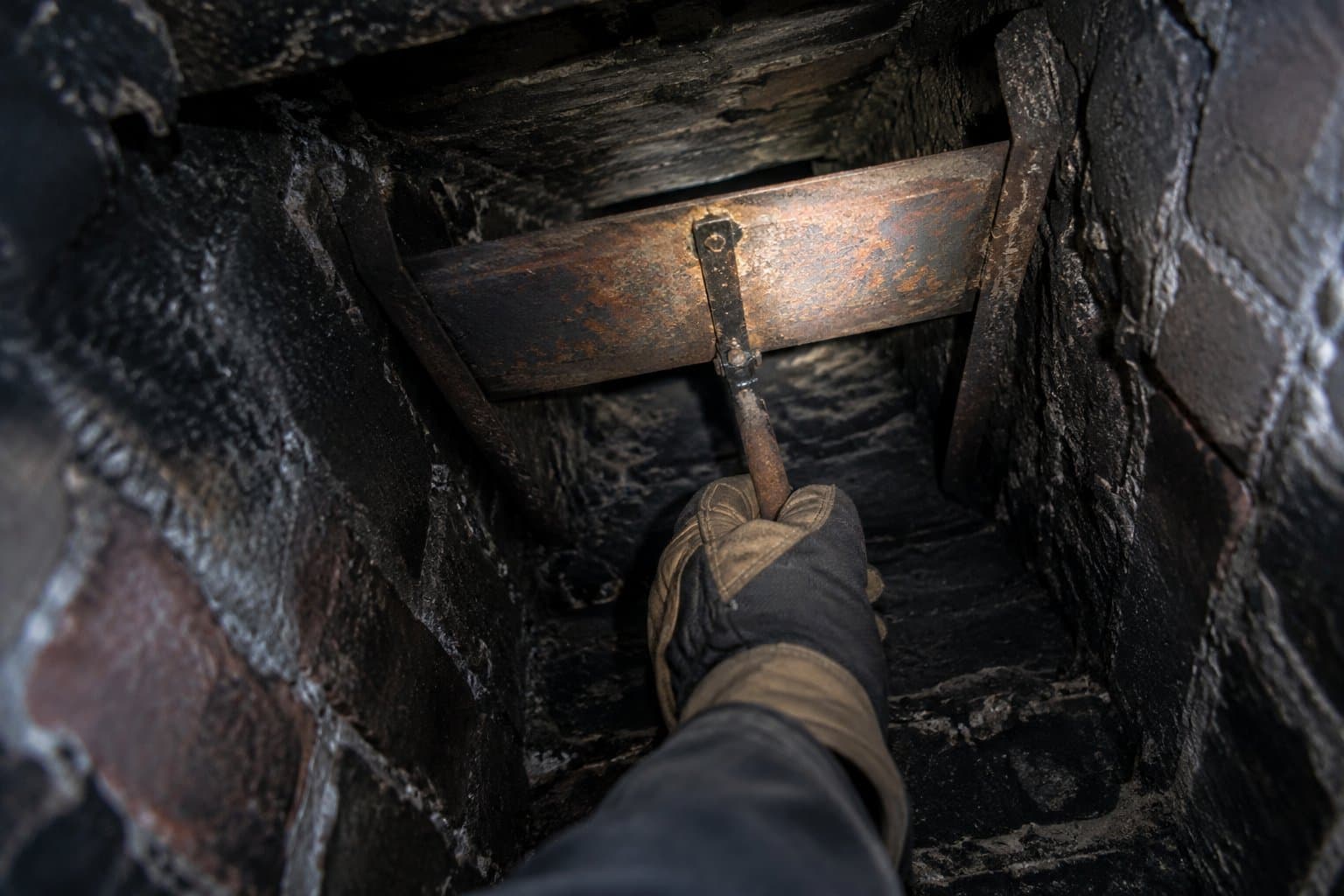
In Binghamton the usual cause is water. An uncapped flue lets rain and snowmelt land straight on the damper plate, and the damp, cloudy weather here keeps it from ever really drying out. Then the freeze-thaw cycles work on the metal and on the mortar around the throat. A lot of houses in the city were built before 1940 — Victorians, foursquares, two-family homes with full basements and original masonry chimneys — and many of those chimneys were built for coal or oil and lined later for gas. The dampers in them have had a long time to seize up.
While you wait — please don't
- Do not light a fire until you know the damper is open. Put your head in the firebox with a flashlight and look up — if you cannot see daylight or an open throat, do not burn anything.
- Stop using the fireplace if smoke came into the room. Smoke in the living room means the flue is not carrying it out, and the same path that brought smoke in can bring carbon monoxide.
- Get outside and call 911 if a CO alarm sounds or anyone feels sick. Headache, nausea, dizziness or drowsiness around a fire are carbon monoxide symptoms, and you deal with that from outside the house, not inside it.
- Do not force a rusted damper. Levering hard on a seized plate can crack the frame or the surrounding masonry and turn a hardware repair into a masonry job.
- Do not close a damper on warm ashes. A fire that looks out can still be producing carbon monoxide, so leave the damper open until the ashes are cold.
What the technician does
- The damper gets looked at firstThe technician opens up the firebox and checks whether the plate, the frame or the hardware is the problem. That decides whether it can be freed or needs replacing.
- Freed, cleaned and re-seatedWhere the plate is sound, the rust and debris are cleaned off and the damper is re-seated so it closes flat in its frame again. A damper that does not seal is still costing you heat.
- Handles, pivots and hardware replacedWorn or broken handles, pivots and pins are swapped for new ones so the damper works from the room the way it should.
- A top-sealing damper where the throat damper is finishedIf the original is rusted beyond repair, a top-sealing damper can be fitted at the top of the flue instead. It seals with a gasket at the top of the chimney and is operated by a cable down into the firebox.
- The flue swept while it is accessibleWith the damper open and the firebox clear, it makes sense to sweep the flue at the same time rather than coming back to it later.
- A cap fitted to stop the waterIf the flue is uncapped, a cap keeps the rain and snow off the damper and the smoke shelf. That is what rusted it in the first place.
Why this happens in Binghamton, NY
Binghamton's heating season runs long — roughly October through April — so a damper that will not close is not a small loss. You are feeding warm air up an open flue for six or seven months. A damper that will not open is worse, because the first fire of the season pushes smoke back into the room. Either way it is worth sorting before the cold sets in. Demand around here peaks in late summer and fall, when people get chimneys, flues and vents serviced ahead of winter, and again in spring when freeze damage shows itself.
The older housing on the West Side, East Side, North Side and First Ward tends to have original masonry chimneys with throat dampers that have been in place a very long time. Repeated freeze-thaw cycles crack crowns and mortar joints, and once water is getting in at the top it works its way down to the damper and the smoke shelf. Binghamton's damp, cloudy weather means that moisture lingers. If your chimney has no cap, assume water is part of the story. The same work also covers Johnson City, Endicott, Vestal, Endwell, Port Dickinson and Chenango Bridge.
Questions people ask
- How do I tell if my damper is open or closed?
- Use a flashlight and look up into the throat from inside the firebox. An open damper shows you a clear path up the flue; a closed one shows a flat metal plate just above your head. If you cannot tell, leave the fireplace alone until someone has looked at it.
- My damper is stuck open. Is that urgent?
- It is not a fire hazard, but in Binghamton it is an expensive one. With a heating season that typically runs October through April, an open throat draws heated air out of the house the whole time. It also lets cold air, rain and snow come down into the firebox.
- Can a stuck damper be freed, or does it always need replacing?
- It depends on how far the rust has gone. Often the plate can be cleaned, freed and re-seated with new hardware. Where the frame itself has corroded past the point of sealing, a top-sealing damper at the top of the flue is the usual alternative.
- Do I need a permit for this in Binghamton?
- In New York, permits are issued locally by the municipal or county building department, not by a state agency. Routine sweeping and inspection generally do not require one, but structural masonry work above the roofline usually does. Call the Binghamton building department before work begins, since requirements vary between jurisdictions.
- Is One Call Chimney the company doing the work?
- No. We are a referral and scheduling service that arranges chimney work with independent sweeps and masons across all fifty states. The technician who comes out is the contractor, and they give you the price after inspecting the chimney.
- How do I know what I am paying for?
- The estimate is free and comes after the technician has looked at the damper and the flue. Ask them to show you what they found and to put the reasoning in writing before you approve anything.
One call
Call (866) 576-7943 and we will arrange for an independent chimney technician to come out and look at the damper. The estimate is free, the price comes before any work starts, and nothing happens until you approve it.
More from One Call Chimney
Something else in this area
- Rebuild or new chimney
- Smoke comes back into the room
- Never been swept
- Water coming in
- Something living up there
- Smells of smoke or damp
- Cracked crown or crumbling brick
- Liner damaged or missing
One Call Chimney arranges the visit; the technician does the work and gives you the price.