
Cracked crown or crumbling brick in Albany, NY
The slab of concrete on top of your chimney is the crown. It sheds rain away from the brick and the flue below. When it cracks, water gets in. From there the damage works downward: mortar joints soften, brick faces flake off, and pieces start landing in the yard or the alley. If you are finding chips of brick on the ground or you can see the top of the stack is open, that is what has happened.
Phones answered around the clock · free estimate
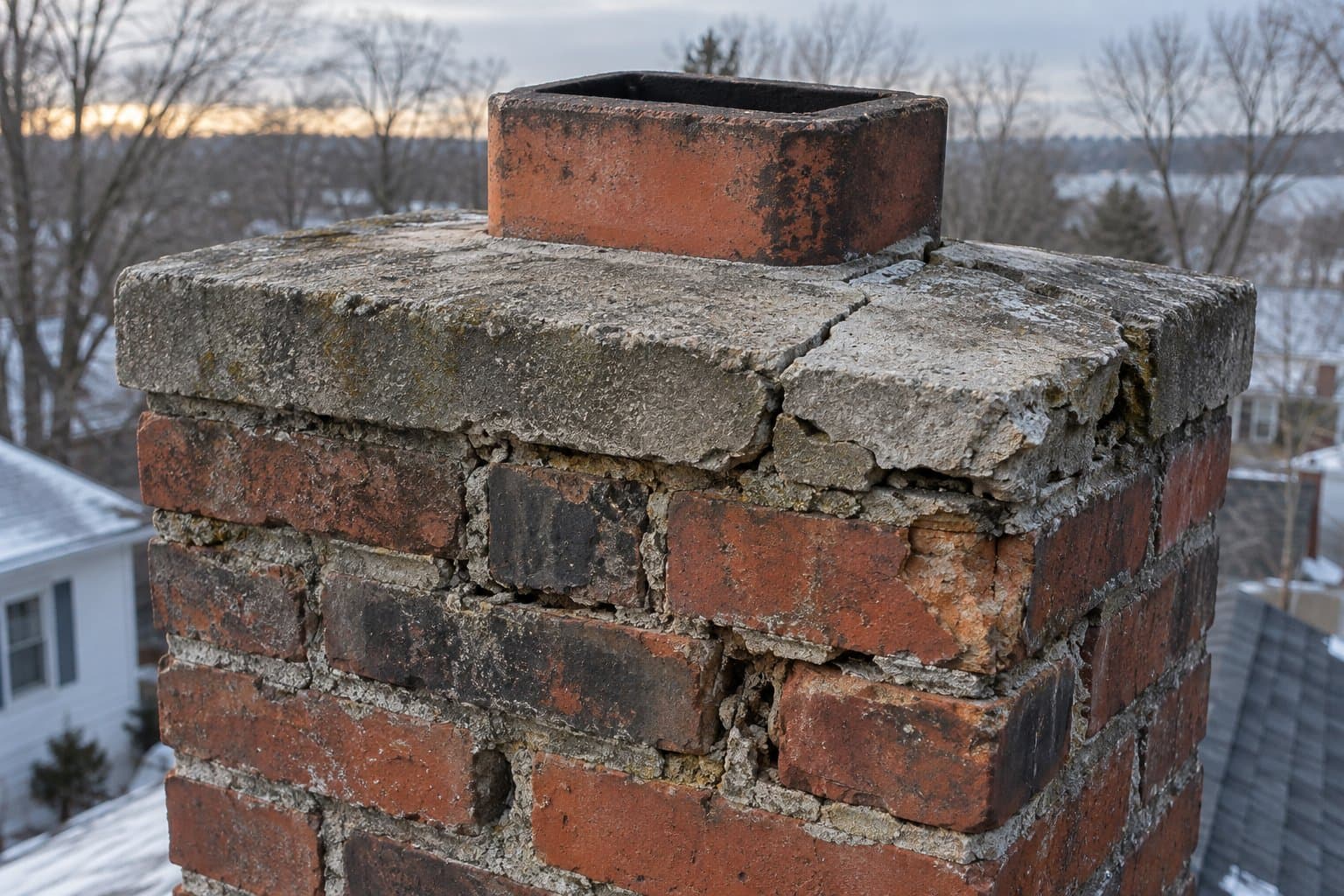
Albany is hard on masonry chimneys. Winters here run long and cold, with stretches below freezing, and every freeze-thaw cycle pushes trapped water inside the brick a little further apart. That is what turns a hairline crack into a rebuild. The city also has some of the oldest housing stock in the country — pre-1940 brick and frame homes, rowhouses downtown, bungalows and colonials on the west side — and many of those chimneys were built for coal or oil heat and have been weathering upstate New York winters for a very long time.
While you wait — please don't
- Keep people away from the base of the chimney. Falling brick from roof height is a real hazard at ground level, so move cars, bins and anything you walk past every day out from under the stack.
- Do not light a fire if the stack is leaning or open. A stack that is tilting or has open gaps in it is a structural problem, not a cosmetic one, and gaps in masonry can let combustion gases into the house instead of out the top.
- Get out and call 911 if a CO alarm sounds. If your carbon monoxide alarm goes off, or anyone in the house is dizzy, nauseous or has a headache that clears when they step outside, leave the building first and call from outside.
- Do not patch it yourself from a ladder in winter. Icy roofs, loose brick and a crown that has already lost structure are a bad combination, and a smear of sealant over a crack traps the water that caused it.
What the technician does
- The technician looks at the whole stackNot just the crack. The crown, the mortar joints, the brick faces and the section above the roofline are all checked together, because they usually fail as one.
- The crown is repaired or recastWhere the crown is beyond patching, it is recast with an overhang and a drip edge so rainwater is thrown clear of the brick instead of running down the face of it.
- Repointing where the joints have goneOpen or crumbling mortar joints are cut out and repointed, matched to the existing work so the repair sits in with the rest of the chimney.
- Spalled brick cut out and replacedBrick that has flaked or split from frozen water is removed and new brick set in its place. Leaving it in means the next winter takes more of it.
- A cap fitted on topA cap keeps rain, snow and animals out of the flue, which is the main way water gets into a masonry chimney once the crown is sound again.
- Rebuild above the roofline if neededWhere the stack has lost structure, the section above the roof is taken down and rebuilt. The technician explains why that call was made before anything starts.
Why this happens in Albany, NY
Freeze-thaw and road salt are the main stressors on masonry in Albany. The city sits about 140 miles inland on the Hudson, so there is no salt-air exposure, but repeated freezing and thawing through a long heating season does the same slow damage to crowns and mortar joints. Summers here are humid, which keeps an unused flue damp, and damp brick going into a cold November is brick that spalls by March.
Housing matters too. In the rowhouse blocks of Center Square, the Mansion District and the South End, shared party walls, narrow alleys and old unlined or long-abandoned flues make chimney work a recurring need — and a crumbling stack over a narrow alley is a hazard for the neighbours as much as for you. In Pine Hills, Delaware Avenue and the other western neighborhoods, the two-family frame houses and 1920s–1950s bungalows and colonials often still have their original masonry chimneys. Demand here peaks in early fall as people prep for the first freeze, and again in the late-winter thaw when the damage shows itself. Masonry rebuilding and repointing concentrate in the warmer months, since mortar needs to cure without freezing.
Questions people ask
- Is a cracked crown urgent, or can it wait until spring?
- A hairline crack with sound brick underneath can often wait for warmer weather, since mortar cures better then. Loose or falling brick, open gaps or a leaning stack should be looked at now, because those are structural. Have someone inspect it and tell you which one you have.
- Do I need a permit for chimney work in Albany?
- In New York, permits are issued locally by the municipal or county building department, not by a state agency. Structural masonry work such as rebuilding a chimney above the roofline typically needs one, while routine sweeping and inspection generally do not. Call the local building department before work begins.
- Is there a state chimney licence I should check for?
- New York does not issue a statewide licence for chimney sweeping, inspection or masonry repair. It is handled locally, and many upstate municipalities require only local registration or nothing at all. You can verify current requirements with the city or county consumer affairs or licensing office.
- Why did this happen to a chimney that has stood for a hundred years?
- Albany has large numbers of pre-1940 homes, and many of those chimneys were originally built to vent coal or oil heat. Once the crown lets water in, the long cold winters here work on it every single freeze-thaw cycle until the brick gives up.
- How do I know the repair recommended is the right one?
- Ask the technician to show you what they found and to put the reasoning in writing. If they used a camera in the flue, ask to see the footage. You approve the price before any work starts.
One call
One Call Chimney is a referral and scheduling service — we arrange the work with independent sweeps and masons across all fifty states, and we are not the contractor. Call (866) 576-7943 for a free estimate: the technician inspects the chimney and gives you the price before any work starts, and you approve it first.
Something else in this area
- Something living up there
- Smoke comes back into the room
- Never been swept
- Water coming in
- Smells of smoke or damp
One Call Chimney arranges the visit; the technician does the work and gives you the price.