
Stop using the fireplace
Liner damaged in Utica, NY
Someone has looked up your chimney and told you the liner is cracked. That liner is the layer that keeps heat and combustion gases inside the flue and away from the wood framing and brick of your house. When it breaks, heat can reach the structure and carbon monoxide can find its way into the rooms you live in. Until the flue has been checked and verified, do not light a fire or run the appliance that vents into it.
Phones answered around the clock · free estimate
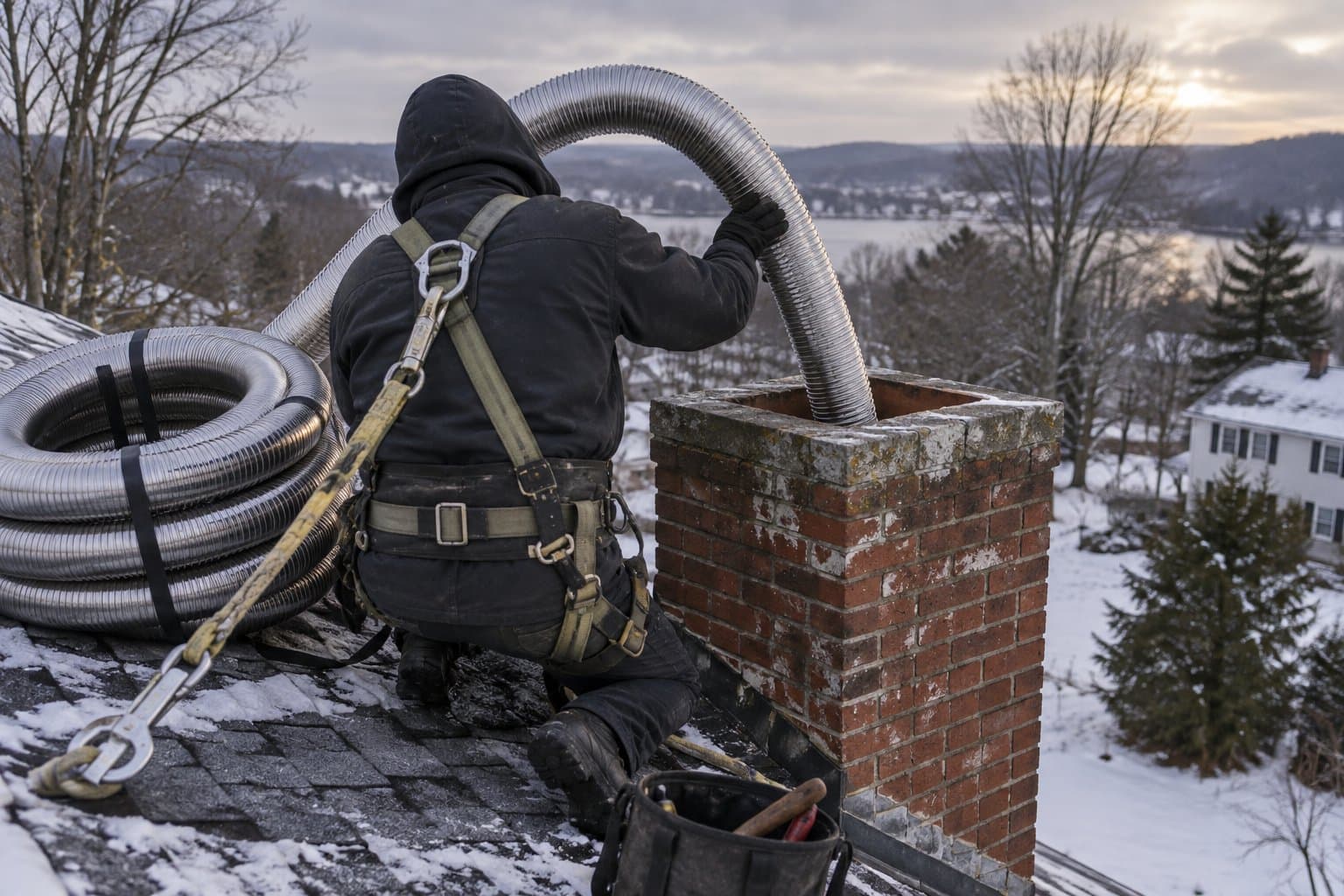
This is common in Utica. The housing stock here is unusually old, dominated by pre-1940 wood-frame and brick homes with original masonry chimneys, and many of those flues were built for coal or early oil heat and are still in service behind a modern furnace. Winters are long and cold with frequent sub-zero nights, and the repeated freeze-thaw cycles crack mortar joints and chimney crowns. Once a crown lets water in, the flue stays damp, and damp clay tile does not survive heating and cooling well. A chimney fire cracks clay tiles outright. So does converting an old chimney to gas without relining, because the acidic condensate goes to work on the masonry.
While you wait — please don't
- Stop using the fireplace or appliance. A damaged liner lets heat and carbon monoxide reach the structure of the house, so nothing should be burned in it until the flue is inspected and verified.
- If anyone feels sick, get out and call 911. Headache, nausea, dizziness or sleepiness in more than one person, or a CO alarm sounding, means everyone goes outside first and you call 911 from outside.
- Do not relight after a chimney fire. After any chimney fire the flue must be inspected before it is used again, because the heat can crack tiles even when the brick outside looks untouched.
- Do not patch it from below. Sealants and pour-down fixes applied without a camera inspection cannot confirm the full length of the flue is sound, and the only way to know is to look.
What the technician does
- Camera inspection firstThe technician runs a camera the full length of the flue before quoting anything. Ask to see the footage yourself and ask for the reasoning in writing.
- Appliance and flue matchedThe liner has to suit what it vents — wood stove, fireplace, furnace or boiler. Size, material and termination are all matched to the appliance.
- Stainless steel liner sized to the applianceA stainless liner is sized rather than guessed, and insulated where that is required. An oversized flue drafts poorly and runs cold.
- Cast-in-place lining where appropriateSome older masonry chimneys suit a cast-in-place lining instead. The technician will tell you which option fits your chimney and why.
- Cap and crown addressed at the same timeThere is little point in a new liner if water keeps coming through a cracked crown. The cap and crown are dealt with as part of the same job.
- Price before work startsThe technician inspects the chimney and gives you the price before anything begins. You approve it first.
Why this happens in Utica, NY
Utica's Victorians, foursquares and two-family doubles mostly have full basements and original masonry chimneys, and a good number of those chimneys were sized for coal. A modern furnace puts very different gases through a flue than the appliance it was built for. That is why relining and crown repair come up so often in East Utica, Cornhill, South Utica and the older streets around Proctor Park, and in neighbouring places like New Hartford, Whitesboro, Yorkville and Rome.
Timing matters here. Demand peaks in early fall as people prepare chimneys and furnaces before the snow, and again in the late-winter and spring thaw when masonry and water damage surface. Lake-effect snow off Lake Ontario loads the roof and stresses flashing and caps, and humid summers keep an unused flue damp. If you have been told the liner is cracked, getting the inspection done outside the mid-winter rush usually makes the work easier to schedule. In New York, permits for chimney work are issued locally, and relining as part of an appliance installation typically needs one — call the Utica building department before work begins.
Questions people ask
- Does a cracked liner really mean I cannot use the fireplace?
- Yes. The liner is what keeps heat and carbon monoxide out of the structure of the house. Leave it cold until a camera inspection confirms the condition of the full flue.
- I converted my old Utica chimney to gas. Why does it need relining?
- Gas appliances produce acidic condensate, and in an unlined or clay-tile masonry chimney that condensate attacks the masonry. Many Utica chimneys were built for coal or early oil heat and were never intended to handle it.
- Do I need a permit in Utica?
- New York issues permits locally, not through a state agency. Relining done as part of a wood stove, pellet stove or insert installation generally requires one, and so does structural masonry above the roofline. Call the Utica code enforcement office before work starts.
- Is there a state chimney licence I should ask about?
- New York does not issue a statewide licence for chimney sweeping, inspection or masonry repair — it is handled locally, and many upstate municipalities require only local registration. You can verify current requirements with the city or county licensing office.
- What does One Call Chimney actually do?
- We are a referral and scheduling service that arranges chimney work with independent sweeps and masons across all fifty states. We are not the contractor and we do not perform the work ourselves.
One call
Call (866) 576-7943 and we will arrange for an independent technician to inspect the chimney and give you a free estimate. You see the price and approve it before any work starts.
More from One Call Chimney
Something else in this area
- Smoke comes back into the room
- Never been swept
- Rebuild or new chimney
- Water coming in
- Something living up there
- Smells of smoke or damp
- Cracked crown or crumbling brick
- Damper stuck or broken
One Call Chimney arranges the visit; the technician does the work and gives you the price.