Stop using the door
Liner damaged in Syracuse, NY
Someone has looked up your chimney and told you the liner is cracked. That liner is the inside surface of the flue — usually clay tile in an older Syracuse house, sometimes metal. Its job is to keep heat, smoke and combustion gases inside the flue and away from the brick, the framing and the rooms you live in. When it cracks, that separation is gone.
Phones answered around the clock · free estimate
This is common here. Syracuse has a long heating season, and flues stay in near-constant use through it. Repeated freeze-thaw cycling is hard on chimney crowns, mortar joints and brick faces, especially once a flue has absorbed moisture, and much of the city's housing stock was built before 1940 with masonry chimneys. Across New York, unlined or clay-tile masonry chimneys needing relining are very common. Clay tiles also crack during a chimney fire, and a chimney converted to gas without relining leaves acidic condensate to attack the masonry from the inside.
While you wait — please don't
- Stop using the fireplace or appliance. A damaged liner lets heat and carbon monoxide reach the structure of the house, so the appliance should not be used again until the flue has been verified.
- If anyone feels sick, get out and call 911. Headache, dizziness, nausea or confusion in more than one person, or a CO alarm sounding, means everyone goes outside first and you call 911 from outside.
- Do not use it again after a chimney fire. After any chimney fire the flue must be inspected before it is used again, even if the fire seemed to put itself out.
- Do not switch the fireplace to gas without settling the liner first. Gas appliances produce acidic condensate, and without a correctly sized and matched liner that moisture works on the masonry.
What the technician does
- Camera inspection firstThe technician runs a camera up the flue before anything is priced or ordered. That footage shows where the cracks are, how far they run, and whether the damage is one tile or the whole length.
- The appliance and the flue get matchedA liner has to suit what it is venting. Size, material and termination are matched to the appliance, whether that is an open fireplace, a wood stove, a pellet stove or a gas or oil furnace.
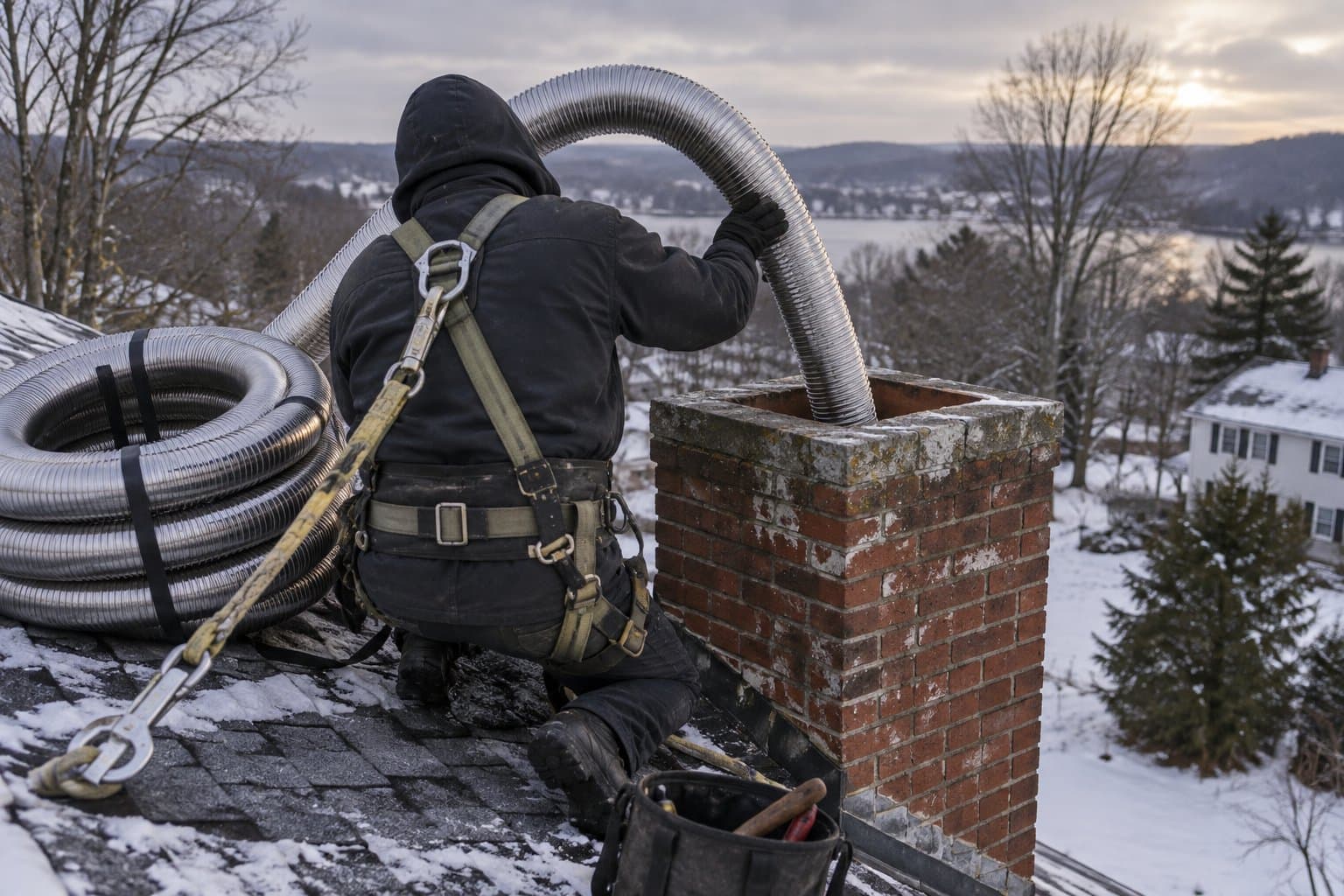
- Stainless steel liner, insulated where requiredThe usual repair is a stainless steel liner sized to the appliance and insulated where the installation calls for it. Insulation helps the flue hold its temperature, which matters over a long Syracuse heating season.
- Cast-in-place lining where it fits the chimneySome chimneys are better served by a cast-in-place lining. The technician will tell you which approach suits your flue and why.
- Cap and crown addressed at the same timeWater is what breaks liners down, so the crown and the cap are dealt with as part of the job rather than left for later.
- The price comes before the workThe technician inspects the chimney and gives you the price before any work starts. You approve it first.
Why this happens in Syracuse, NY
Syracuse is among the snowiest large cities in the country because of lake-effect snow off Lake Ontario, and snow load and ice put stress on chimney flashing, crickets and caps. Century-old brick chimneys around the city commonly show spalling and mortar loss from freeze-thaw cycling and need periodic repointing and liner inspection. If your chimney is one of those, the liner problem and the masonry problem often arrive together, which is why the crown and cap get looked at during a relining job.
Timing matters here. Demand climbs in early fall as people prepare heating systems before the snow, and again in the spring thaw when winter damage shows up. Exterior masonry work such as repointing concentrates in warmer months, when mortar can cure without freezing, so if the inspection turns up brickwork alongside the liner, the technician may sequence the two. In Syracuse, permits for chimney work come from the local building department, not a state agency — relining as part of an appliance installation usually needs one, and routine sweeping and inspection generally do not. Call your local code enforcement office before work begins. New York does not issue a statewide chimney sweep or chimney inspection license, so verify current requirements with the city or county licensing office.
Questions people ask
- Can I use the fireplace until the liner is replaced?
- No. A cracked liner lets heat and carbon monoxide reach the structure of the house, and the appliance should not be used until the flue is verified. If a CO alarm sounds or anyone feels unwell, get everyone outside and call 911.
- How do I know the liner really is cracked?
- Ask to see the camera footage. Ask for the reasoning in writing too, so you have a clear record of what was found and where.
- My Syracuse house was built before 1940. Does that change anything?
- Often, yes. Much of the city's housing stock predates 1940, and unlined or clay-tile masonry chimneys are very common in older New York homes, so the camera inspection may find the flue was never lined to modern standards rather than simply damaged.
- I want to convert my fireplace to gas. Do I still need a liner?
- Talk it through with the technician before you convert. Converting to gas without relining leaves acidic condensate attacking the masonry, and the liner has to be matched to the appliance for size, material and termination.
- Is there a charge for the estimate?
- No. The technician inspects the chimney and gives you the price before any work starts, and you approve it first. One Call Chimney is a referral and scheduling service that arranges the work with independent sweeps and masons — we are not the contractor and we do not perform the work.
One call
Call (866) 576-7943 and we will arrange for a chimney technician to come out to your Syracuse home, run a camera up the flue and give you a free estimate. Nothing is done until you have seen the price and agreed to it.
Something else in this area
- Never been swept
- Smoke comes back into the room
- Water coming in
- Something living up there
- Smells of smoke or damp
- Damper stuck or broken
- Cracked crown or crumbling brick
- Rebuild or new chimney
One Call Chimney arranges the visit; the technician does the work and gives you the price.