
Stop using the fireplace
Liner damaged in Troy, NY
Someone has looked up your chimney and told you the liner is cracked. That liner is the inner surface of the flue. It is usually clay tile in an older Troy chimney, and its job is to keep heat, smoke and carbon monoxide inside the flue and away from the wood framing and brick of your house. When it cracks, that barrier has a gap in it.
Phones answered around the clock · free estimate
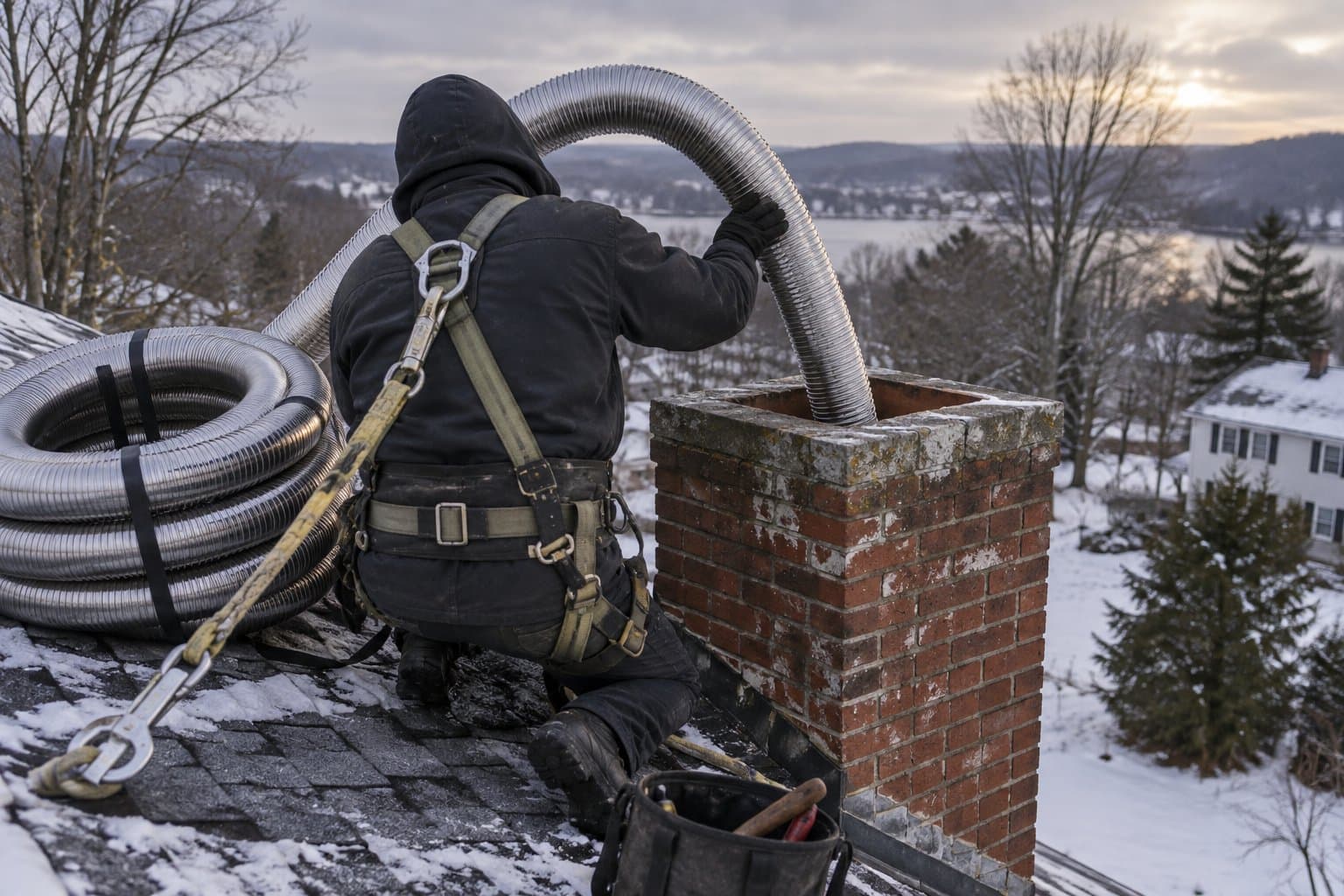
There are a few common reasons this happens here. A chimney fire heats clay tile fast and unevenly, and the tile cracks or shears. Water is the other big one. Troy gets cold, snowy winters with frequent freeze-thaw cycles, and a flue that has absorbed moisture breaks down faster each time it freezes and thaws. Damp summers keep unused flues wet, which does not help. And if an old fireplace or boiler flue was switched over to gas without being relined, acidic condensate sits in the masonry and eats at it from the inside.
While you wait — please don't
- Stop using the appliance. A damaged liner can let heat and carbon monoxide reach the structure of the house, so do not light another fire until the flue has been inspected and verified.
- If you feel sick or an alarm sounds, get out. Headache, dizziness, nausea or a CO alarm going off means everyone goes outside first and you call 911 from there.
- Do not use the flue again after a chimney fire. After any chimney fire the flue must be inspected before it is used again, even if the fire seemed to go out on its own.
- Do not seal or patch a cracked tile yourself. Smearing mortar or sealant over a visible crack does not restore the liner, and it hides damage the camera needs to see.
What the technician does
- Camera inspection firstThe technician runs a camera down the flue before anything is quoted. That is how the crack, the gap or the spalled tile is actually located and confirmed.
- The appliance and flue get matchedThe liner has to suit what is venting into it — size, material and termination all have to line up with the appliance. A wood stove, an open fireplace and a gas appliance do not all want the same thing.
- Stainless steel liner, sized and insulatedMost relines use a stainless steel liner sized to the appliance, insulated where that is required. Insulation helps the flue stay warm enough to draft properly through a long Troy heating season.
- Cast-in-place where it fits the chimneySome older masonry chimneys are better suited to a cast-in-place lining. The technician will tell you which approach they are recommending and why.
- Cap and crown handled at the same timeThe crown and cap are what keep rain and snowmelt out of the flue. They get addressed as part of the same job, because a new liner under an open, cracked crown is a short-lived liner.
- The price comes before the workThe technician inspects, then gives you the price. You approve it before anything starts.
Why this happens in Troy, NY
Troy's housing stock is old even by Northeast standards. The 19th- and early-20th-century brick rowhouses, the two- and three-family wood-frame homes, the Victorian-era masonry — a great many of them have original flues, some working, some decommissioned. Unlined or clay-tile masonry chimneys are very common across New York, and relining is one of the most frequent things those chimneys need. In the Collar City's rowhouse blocks you also get party walls and shared chimney stacks, so a technician will want to be clear about which flue serves which appliance before proposing anything.
Season matters too. Demand climbs in early fall as people across Troy get chimneys ready before the heating season, and again at the spring thaw when freeze damage finally shows itself in crowns, mortar joints and brick faces. Upstate New York runs a long heating season, roughly October through April, so a flue here works hard. In New York, permits for chimney work are issued locally, by the municipal or county building department and code enforcement officer, not by a state agency — and relining a flue as part of an appliance installation typically needs one. Solid-fuel work is commonly evaluated against the Uniform Code, NFPA 211 and the appliance manufacturer's listed instructions. Call Troy's building department before work begins to confirm what applies to you.
Questions people ask
- Can I use the fireplace until the reliner comes?
- No. A damaged liner lets heat and carbon monoxide reach the structure of the house, and that risk is there from the first fire. Leave it cold until the flue has been inspected and verified.
- How do I know the crack is really there?
- Ask to see the camera footage. Ask for the reasoning in writing too, including which flue was inspected and what the technician recommends. On a Troy rowhouse with a shared stack, that written detail is worth having.
- We converted the fireplace to gas. Does that still need a liner?
- Often yes. Converting to gas without relining leaves acidic condensate sitting against the masonry, and over time it attacks it. The camera inspection will show what condition the flue is in now.
- Is relining better done in warmer weather?
- Exterior masonry rebuilding and repointing in New York concentrate in the warmer months, when mortar can cure without freezing. If crown or brick repair is part of your job, the technician will factor Troy's freeze-thaw winters into the plan.
- Who actually shows up?
- One Call Chimney is a referral and scheduling service. We arrange the work with independent sweeps and masons — we are not the contractor and we do not perform the work ourselves.
One call
One call to (866) 576-7943 gets a chimney inspection arranged at your Troy address, and the estimate is free. The technician inspects the chimney and gives you the price before any work starts, and you approve it first.
More from One Call Chimney
Something else in this area
- Smoke comes back into the room
- Never been swept
- Water coming in
- Something living up there
- Smells of smoke or damp
- Cracked crown or crumbling brick
- Damper stuck or broken
- Rebuild or new chimney
One Call Chimney arranges the visit; the technician does the work and gives you the price.