
Water coming in in Albany, NY
You have a damp patch on the ceiling next to the chimney, or a stain running down the wall behind it. Water is getting into the chimney somewhere above and finding its way down through the brick. The wet spot inside is rarely directly under the hole outside, so the leak has to be traced rather than guessed at.
Phones answered around the clock · free estimate
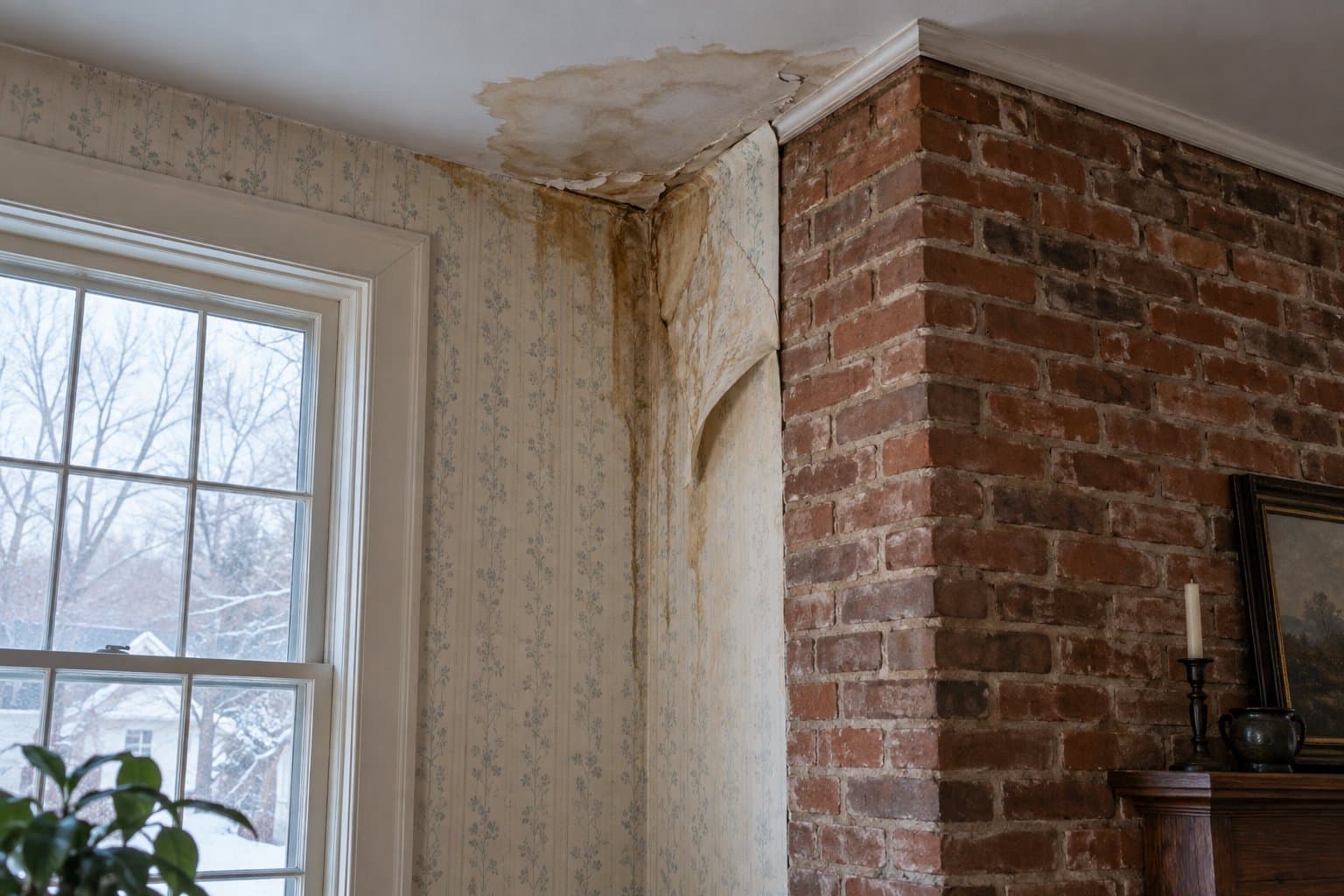
There are only a handful of usual entry points: the flashing where the chimney meets the roof, a cracked or poorly shaped crown at the top, a missing or damaged cap letting rain straight down the flue, and open mortar joints or spalled brick in the stack itself. Albany makes all four worse. The winters here run long stretches below freezing, and repeated freeze-thaw cycles widen every crack they find. Water soaks into brick and mortar, freezes, expands, and opens the gap a little more each time. Wind-driven rain adds to it, pushing in at angles where ordinary rain would simply run past. Heavy upstate snow loads put their own stress on flashing, crickets and caps.
While you wait — please don't
- Do not paint or patch over the stain. Covering the mark inside hides the evidence a technician uses to trace where the water is actually coming in.
- Stop burning if water has reached the firebox or flue. A liner that has been soaked or cracked by freezing water may no longer contain heat and combustion gases safely, so leave the fireplace unused until it has been inspected.
- Get out and call 911 if you have a carbon monoxide alarm or feel unwell. Headache, nausea or dizziness around the fireplace can mean combustion gases are entering the room — go outside first, then call.
- Keep clear of the base of the chimney. A chimney that has been wet for years can become structurally unsound, and falling brick is a real hazard at the bottom of the stack.
- Do not go up on the roof to look. Albany roofs are icy or snow-covered for much of the heating season, and the inspection needs to be done from the top down anyway.
What the technician does
- The entry point gets tracedThe technician works out where the water is actually getting in rather than sealing over the nearest crack. That means looking at the crown, the cap, the flashing and the brickwork together, and following the path down to the stain you can see.
- Flashing is replaced and counter-flashedWhere the roof meets the chimney, new flashing is fitted and counter-flashed into the mortar joint so water is shed away from the joint instead of running behind it. This is one of the most common sources of a ceiling stain next to the chimney.
- The crown is repaired or recastThe concrete crown at the top sheds rain off the chimney. If it is cracked or worn through, it gets repaired, or recast so it drains properly and overhangs the brick.
- A cap is fittedA cap keeps rain and snow out of the open flue. It also keeps animals and debris out of the top of the chimney.
- Repointing and brick replacementOpen mortar joints are raked out and repointed, and brick faces that have spalled — crumbled or flaked off — are cut out and replaced so the stack is sound again.
- Breathable water repellent where appropriateOn suitable masonry, a breathable repellent slows water absorption while still letting the brick dry out. It is applied where it makes sense for the chimney, not as a substitute for the repair.
Why this happens in in Albany, NY
Albany has some of the oldest housing stock in the country, with large numbers of pre-1940 brick and wood-frame homes. In the dense rowhouse blocks of Center Square, the Mansion District and the South End, shared party walls, narrow alleys and long-abandoned masonry flues make leaks awkward to trace — water can enter high on a shared stack and show up on a ceiling some distance away. Many of these chimneys were originally built for coal or oil heat, and an unlined flue offers very little resistance to water working its way down through the brick.
Timing matters here. Demand in Albany peaks in early fall, when people are getting heating systems and chimneys ready before the first freeze, and again during the late-winter and spring thaw, when ice-dam and masonry damage from the winter finally shows itself. If your stain appeared in March, that is exactly the pattern. Exterior masonry work — repointing and rebuilding — concentrates in the warmer months across New York, because mortar needs to cure without freezing. And Albany sits about 140 miles inland on the Hudson, so there is no salt-air exposure; here it is freeze-thaw and road salt doing the damage, along with humid summers that keep an unused flue damp and encourage odors and interior staining.
Questions people ask
- The stain is a few feet from the chimney. Is it still the chimney?
- Very possibly. Water that enters at flashing or crown level can travel along framing or down inside the masonry before it shows. That is why the entry point is traced instead of sealed over at the first crack found.
- Do I need a permit for chimney work in Albany?
- In New York, permits are issued locally by the municipal or county building department, not by a state agency. Routine sweeping and inspection generally do not need one, but structural masonry work such as rebuilding a chimney above the roofline typically does. Call the local building department before work begins.
- Is there a state license for chimney work in New York?
- New York does not issue a statewide license for chimney sweeping, inspection or masonry repair. It is handled locally, and many upstate municipalities require only local registration or nothing at all. Verify current requirements with the city or county consumer affairs or licensing office.
- Can this wait until spring?
- Leaving it through an Albany winter usually makes it worse, because each freeze-thaw cycle opens the crack a little further. Getting it looked at now tells you what you are dealing with, even if some exterior masonry is better scheduled for warmer weather when mortar can cure without freezing.
- How do I know the diagnosis is right?
- Ask the technician to show you the camera footage and photos of the crown, cap and flashing. Ask for the reasoning in writing alongside the estimate, so you can see how the entry point was identified.
One call
One call to (866) 576-7943 and we arrange a technician to look at your Albany chimney — One Call Chimney is a referral and scheduling service that books independent sweeps and masons, not the contractor doing the work. Every job gets a free estimate: the technician inspects the chimney and gives you the price before anything starts, and you approve it first.
Something else in this area
One Call Chimney arranges the visit; the technician does the work and gives you the price.