
Water coming in in Yonkers, NY
A damp patch on the ceiling beside the chimney means water is getting into the chimney somewhere above that spot and running down inside the structure. It is almost never the ceiling itself. The water finds a gap at the top or the side of the chimney, soaks into the brick or runs down the flue, and shows up on plaster or paint further down. By the time you can see the stain, the water has usually been tracking through for a while.
Phones answered around the clock · free estimate
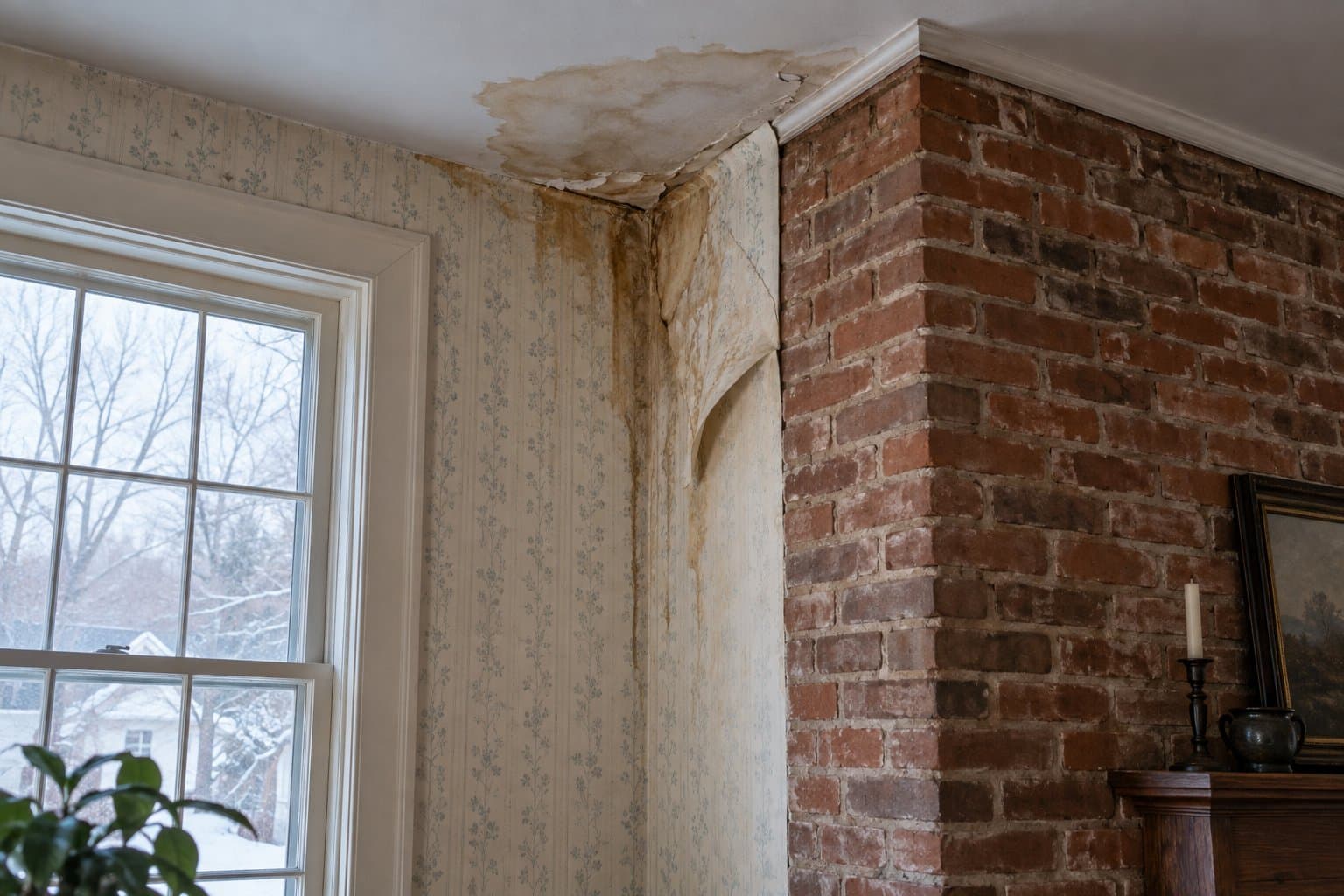
There are only a handful of common entry points. A cracked or worn crown at the very top. A missing or ill-fitting cap, so rain drops straight down the flue. Flashing where the chimney meets the roof that has lifted, rusted or was only sealed over. Open mortar joints and spalled brick faces that drink water in. In Yonkers the weather works on all of them. Winters drop into the teens and twenties and the freeze-thaw cycle repeats over and over, and every time trapped water freezes it widens the crack it is sitting in. Then tropical storm and hurricane remnants — Irene, Sandy, Ida — push wind-driven rain sideways into joints that ordinary rain would run straight past.
While you wait — please don't
- Do not just paint over the stain. Covering the mark hides the evidence while the water keeps coming in and keeps soaking the masonry behind it.
- Stay away from the base of a long-term leak. A chimney that has been wet for years can become structurally unsound, and falling brick is a hazard at the bottom of it.
- Do not light a fire in a soaked flue. Wet masonry and a wet liner can change how the chimney drafts, and if smoke comes back into the room stop using the fireplace until someone has looked at it.
- Get out and call 911 if anyone feels sick. Headache, dizziness or nausea around a working fireplace or heating flue can mean carbon monoxide — leave the house first, then call.
- Do not smear sealant over the flashing. Surface sealant over a flashing gap traps water behind it and the leak usually returns in the next heavy rain.
What the technician does
- The entry point gets tracedThe technician works out where the water is actually coming in rather than sealing over the place where it shows up. That usually means looking at the crown, the cap, the flashing and the brickwork before anything is touched.
- Flashing replaced properlyWhere flashing is the source, it is replaced and counter-flashed into the mortar joint so the joint holds the metal rather than a bead of sealant holding it.
- Crown repaired or recastThe crown is the concrete slab at the top. If it is cracked it can be repaired, and if it has broken up it is recast so water sheds off the top instead of soaking in.
- Cap fittedA cap keeps rain from falling straight down the open flue. It also keeps birds and animals out of the same opening.
- Repointing and spalled brickOpen mortar joints are raked out and repointed, and brick faces that have spalled — popped off from frozen moisture — are cut out and replaced.
- Breathable water repellent where it suitsOn some masonry a breathable repellent is applied afterwards so the brick can still dry out while shedding driven rain. It is used where it is appropriate, not as a substitute for the repair.
- The price comes before the workThe technician inspects the chimney and gives you the price first. You approve it before anything starts.
Why this happens in in Yonkers, NY
Much of the housing in Yonkers predates 1940 — brick and stucco rowhouses, wood-frame and brick two- and three-families, prewar brick apartment buildings and co-ops. Masonry chimneys are very common here, and many were built for oil or coal heat and converted later. That means aging liners, deteriorated crowns and repointing are routine work in neighborhoods like Getty Square, Nodine Hill, Park Hill and Ludlow Park, and just as common in the postwar homes out toward Crestwood, Colonial Heights and Runyon Heights. A century-old crown that has taken twenty-five to thirty inches of snow a year, every year, does not stay watertight on its own.
Timing matters. Leaks show up worst during winter storm season and again in spring, when the damage freeze and thaw did over the winter finally becomes visible on the masonry. Exterior masonry work such as rebuilding and repointing concentrates in the warmer months across New York, because mortar needs to cure without freezing. So if you have found a stain now, it is worth getting the chimney looked at now — the inspection tells you whether this is a cap or flashing job that can be done soon or a masonry repair better scheduled for milder weather. One Call Chimney arranges work in Yonkers and the surrounding Westchester towns, including Bronxville, Tuckahoe, Hastings-on-Hudson, Eastchester and Mount Vernon.
Questions people ask
- The stain is only there after heavy rain. Is it still worth looking at?
- Yes. An intermittent stain usually points to wind-driven rain getting in at flashing or an open joint, which is exactly what storm remnants like Irene, Sandy and Ida brought to Yonkers. It will keep getting in, and each winter freeze widens the gap it came through.
- Do I need a permit for chimney work in Yonkers?
- Permits in New York are issued locally by the municipal building department, not by a state agency. Routine inspection generally does not need one, but structural masonry work such as rebuilding a chimney above the roofline typically does. Call the Yonkers building department before work begins.
- Is there a state chimney licence I should ask about?
- New York does not issue a statewide licence for chimney sweeping, inspection or masonry repair — it is handled at city or county level. Westchester County runs its own home improvement contractor licensing program, so you can verify current requirements with the county consumer affairs or licensing office.
- Can the leak be causing damage I cannot see?
- It can. A chimney that has been wet for years can become structurally unsound, and falling brick is a hazard at the base. Water in the flue also causes creosote odors and interior staining, which is why damp unused flues smell in humid weather.
- How do I know the diagnosis is sound?
- Ask the technician to show you what they found — the camera footage from inside the flue and photos from the roof. Ask for the reasoning in writing alongside the estimate, so you can see which entry point is being repaired and why.
- Are you the ones doing the work?
- No. One Call Chimney is a referral and scheduling service that arranges chimney work with independent sweeps and masons across all fifty states. We are not the contractor and we do not perform the work.
One call
One call to (866) 576-7943 gets a chimney leak in Yonkers scheduled, and the estimate is free on every job. The technician inspects the chimney and gives you the price before any work starts, and you approve it first.
Something else in this area
- Liner damaged or missing
- Never been swept
- Something living up there
- Smells of smoke or damp
- Smoke comes back into the room
- Damper stuck or broken
One Call Chimney arranges the visit; the technician does the work and gives you the price.