
Water coming in in New Rochelle, NY
A damp patch on the ceiling next to the chimney means water is getting into the structure somewhere above it. It is almost never coming down the open flue. It is getting in through the crown at the top, through failed flashing where the chimney meets the roof, through open mortar joints, or through brick faces that have started to break up. The water then tracks down inside the masonry and shows up on your ceiling or wall, often a long way from where it entered.
Phones answered around the clock · free estimate
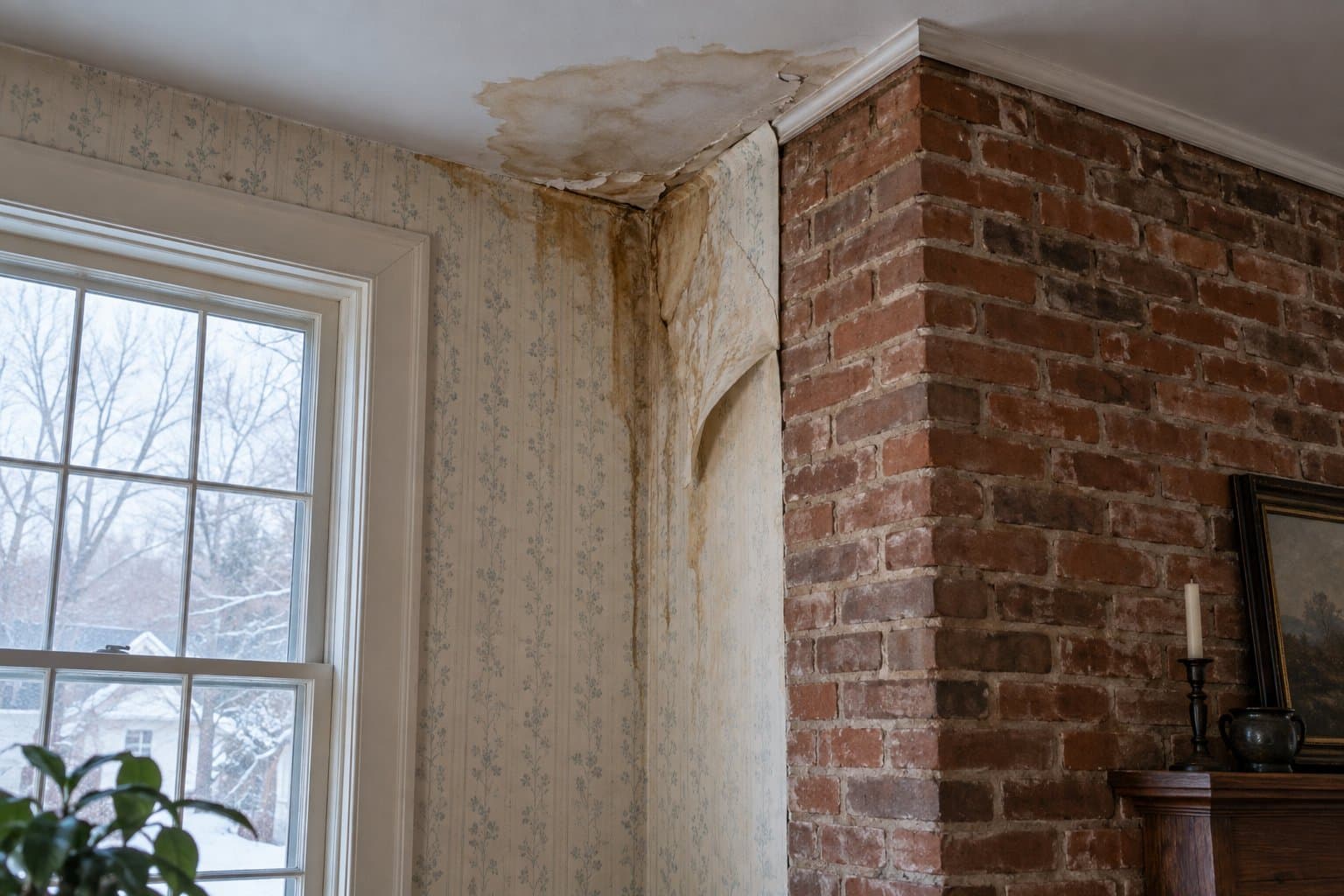
New Rochelle makes this worse in two ways. The winters bring repeated freeze-thaw cycles, and freeze and thaw widens every crack it finds — water soaks into mortar and brick, freezes, expands, and opens the gap a little more each time. On top of that, nor'easters and the remnants of Atlantic storms drive rain sideways, and wind-driven rain gets in where ordinary rain just runs past. Near the Sound, the salt-laden air and high humidity accelerate rust on chimney caps and flashing, so metal that would last inland fails sooner here.
While you wait — please don't
- Do not paint or caulk over the stain. Sealing the inside hides the damp but leaves the water still moving through the masonry, which keeps doing damage you cannot see.
- Do not coat the whole chimney in a sealer. A non-breathable coating can trap water inside the brick, and trapped water freezes and breaks the masonry apart faster.
- Keep away from the base of the chimney outside. A chimney that has been wet for years can become structurally unsound, and falling brick is a hazard at the base.
- Stop using the fireplace if the liner may be wet or damaged. Water damage can crack a clay flue liner, and a damaged liner can let heat and combustion gases reach parts of the house they should never touch.
- If anyone feels sick, dizzy or sleepy near the fire, get out. Those can be signs of carbon monoxide — leave the house, stay outside and call 911.
What the technician does
- The entry point gets traced, not guessedThe technician works out where the water is actually getting in rather than sealing over the stain. The inside damp and the outside damage often sit several feet apart.
- Flashing checked and replacedWhere the chimney meets the roof is the most common entry point. New flashing is counter-flashed into the mortar joint so water is turned out rather than just covered up.
- The crown is repaired or recastThe crown is the concrete slab at the top. Cracks there let water straight down into the chimney, and a cracked crown is usually repaired or cast fresh.
- A cap fittedA cap keeps rain and snow out of the flue opening itself. Along the shoreline it also takes the brunt of the salt air, so the condition of an existing one gets checked.
- Repointing and brick replacementOpen mortar joints are raked out and repointed, and spalled brick — brick with the face broken off — is cut out and replaced.
- Breathable water repellent where appropriateOn sound masonry, a breathable repellent sheds water while still letting the brick dry out. It is used where it helps, not as a substitute for the repair.
Why this happens in in New Rochelle, NY
Much of the New Rochelle housing stock predates 1960 — 1920s to 1950s colonials, Tudors and brick or stucco homes in the north end and along the shore. Masonry chimneys and clay flue liners are widespread in those pre-war houses, and that masonry has been through decades of New York winters. Each freeze-thaw cycle takes a little more out of the mortar joints and the crown. In Rochelle Heights, Residence Park, Sutton Manor and Wykagyl, a leak usually turns out to be an old problem that has finally worked its way through to the ceiling.
On Davenport Neck, Premium Point and the other Sound-front streets, salt air is the extra factor. Caps and flashing corrode faster there, and once flashing has rusted through, wind-driven rain off the Sound finds the gap quickly. Demand across New Rochelle tends to spike after fall nor'easters and tropical remnants, and again in spring when storm and ice damage gets repaired. Exterior masonry work also concentrates in the warmer months in New York, because mortar needs to cure without freezing — so a leak found in January may be patched for the winter and rebuilt properly later.
Questions people ask
- The stain only shows up after heavy rain. Is that still a chimney leak?
- Often yes. Wind-driven rain during a nor'easter hits the chimney from the side and gets past flashing that handles ordinary vertical rain fine. A leak that appears only in storms points the technician toward flashing and the brick faces rather than the crown.
- Do I need a permit for this in New Rochelle?
- In New York, permits for chimney work are issued locally by the municipal building department and code enforcement officer, not by a state agency. Structural masonry work such as rebuilding a chimney above the roofline typically needs one, while routine sweeping and inspection generally do not. Call the local building department before work begins.
- Is there a state chimney licence I should ask about?
- New York does not issue a statewide licence for chimney sweeping, inspection or masonry repair. Westchester County runs its own home improvement contractor licensing programme, so verify current requirements with the county consumer affairs or licensing office for work in New Rochelle.
- Can I keep using the fireplace while I wait?
- If there is any sign the liner is damaged — cracked tiles, pieces of clay in the firebox, smoke or smells coming through walls — stop using it until it has been looked at. If you are unsure, the safe choice is not to light a fire.
- How do I know the diagnosis is right?
- Ask the technician to show you the camera footage of the flue and photos of the crown and flashing. Ask for the reasoning in writing alongside the estimate, so you can see which entry point was found and what the repair addresses.
One call
One Call Chimney is a referral and scheduling service — we arrange the work with independent sweeps and masons and do not perform it ourselves. Call (866) 576-7943 and we will set up a visit in New Rochelle; the technician inspects the chimney and gives you the price before any work starts, and nothing happens until you approve it.
More from One Call Chimney
Nearby
Answers
Free tool
Something else in this area
- Smoke comes back into the room
- Never been swept
- Something living up there
- Smells of smoke or damp
- Cracked crown or crumbling brick
- Damper stuck or broken
- Liner damaged or missing
- Rebuild or new chimney
One Call Chimney arranges the visit; the technician does the work and gives you the price.