Water coming in in Kiryas Joel, NY
A damp patch on the ceiling next to the chimney means water is getting into the structure somewhere above it. It is rarely coming straight down the flue. Most of the time it enters at the flashing where the chimney meets the roof, through a cracked crown at the top, through open mortar joints, or through brick faces that have started to break apart. The water then runs down inside the masonry and shows up on your ceiling or wall some distance from where it started.
Phones answered around the clock · free estimate
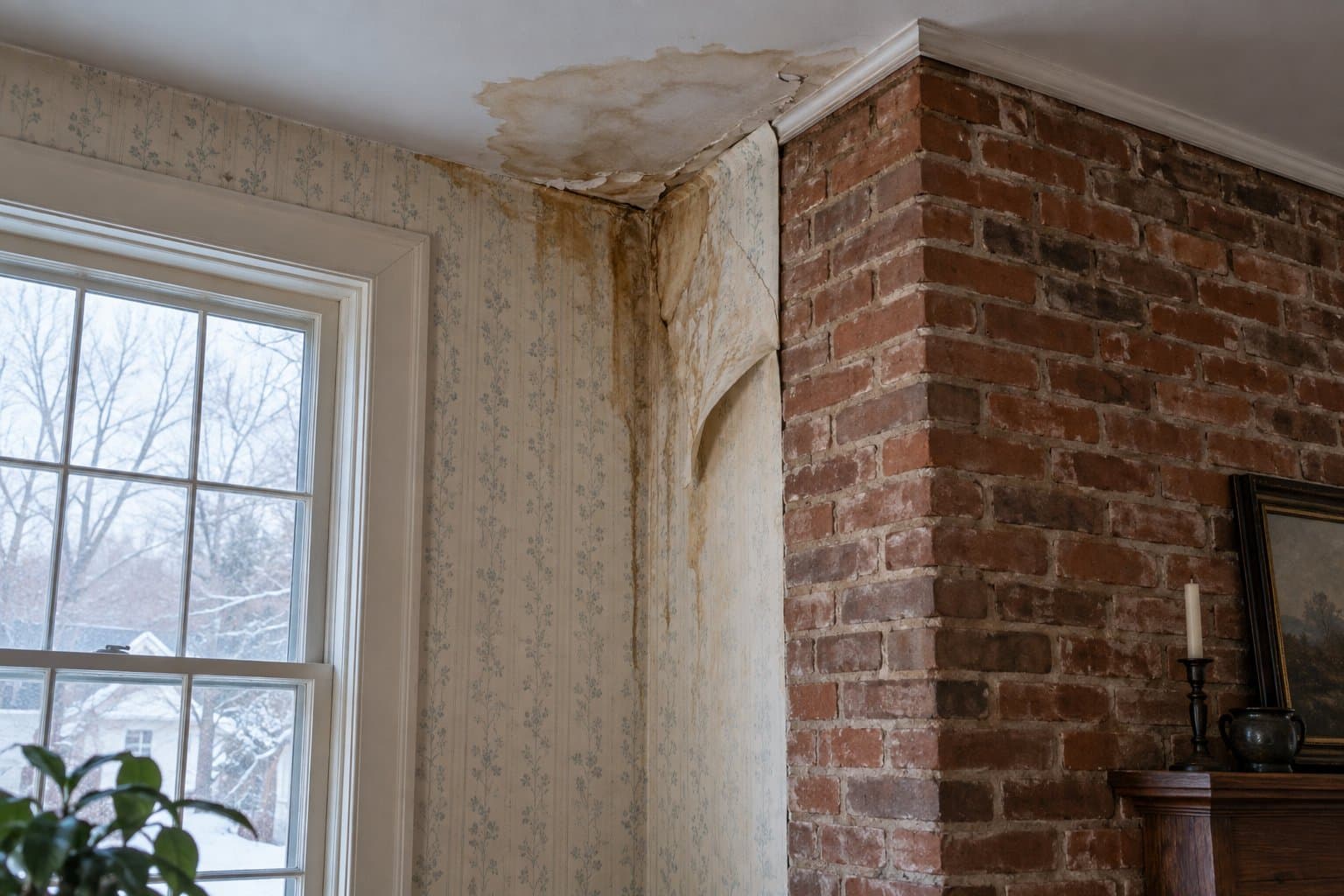
Kiryas Joel sits in the Hudson Valley foothills, and winters here bring repeated freeze-thaw cycles. Water soaks into a hairline crack, freezes, expands, and makes the crack bigger. Do that a few dozen times a winter and a small fault becomes a real opening. Wind-driven rain makes it worse, because it pushes water sideways into joints that ordinary rain would simply run past. Summers here are humid, which keeps an unused flue damp and can bring on creosote odors and staining inside. Most homes in the village are post-1977 attached townhouse-style and condominium units in brick, block and vinyl siding, and most of them rely on gas or oil heat with vented flues — so a chimney that leaks is often still an active venting flue, not a decorative one.
While you wait — please don't
- Do not paint or caulk over the stain. Sealing the inside hides the problem while the water keeps working on the masonry behind it.
- Do not ignore brick or mortar on the ground. A chimney that has been wet for years can become structurally unsound, and falling brick is a hazard at the base.
- Do not use the fireplace if the flue or liner looks damaged. Water damage can crack a liner, and a damaged liner can let smoke and carbon monoxide into the building — stop using it until someone has looked inside.
- Do not wait for anyone to climb up there on a wet or frozen roof. Snow and ice are common here all winter, and the inspection can be done safely rather than quickly.
- Do not stay inside if anyone feels sick or an alarm sounds. If you have headaches, dizziness or nausea around the appliance, or the carbon monoxide alarm goes off, get everyone outside and call 911.
What the technician does
- The entry point is traced, not coveredThe technician works out where the water is actually getting in before anything is sealed. Water travels, so the stain inside is often well away from the opening outside.
- Flashing checked and replacedWhere the chimney meets the roof is the most common entry point. New flashing is counter-flashed into the mortar joint so water is turned out of the joint instead of running behind it.
- Crown repaired or recastThe crown is the concrete surface on top. Freeze-thaw cracks it, and once it is cracked the whole stack takes on water from above, so it is repaired or recast.
- Cap fittedA cap keeps rain and snow out of the flue opening itself and keeps the inside of the chimney drier through a wet Hudson Valley summer.
- Repointing and spalled brick replacedOpen mortar joints are raked out and repointed, and brick faces that have broken apart from freezing are cut out and replaced.
- Breathable water repellent where appropriateOn suitable masonry, a breathable repellent slows absorption while still letting the chimney dry out. It is used where it helps, not as a substitute for the repair.
Why this happens in in Kiryas Joel, NY
Chimneys in and around Kiryas Joel take the full freeze-thaw cycle from roughly October through April. A crown that looked fine in September can open up by February. Because so much of the village is attached, shared-wall construction, a leak in one stack can affect more than one unit, and the work often has to be coordinated across the building rather than treated as one household's problem. Household sizes here are among the largest in the country, so heating systems and their flues run hard, and a wet flue in an active venting chimney is worth dealing with rather than leaving.
Timing matters. Locally, demand climbs in early spring before Passover when households deep-clean and book appliance, vent and flue work, and again in late fall as heating systems are checked before the first freeze. Statewide, exterior masonry rebuilding and repointing concentrate in the warmer months, because mortar needs to cure without freezing. If you are seeing a damp patch now, get it looked at now — the inspection can happen in any season, even if the masonry repair is better scheduled for milder weather. We arrange work in Kiryas Joel and the surrounding area, including Monroe, Woodbury, Harriman, Chester and Goshen.
Questions people ask
- The stain is three feet from the chimney. Is it still the chimney?
- It often is. Water that enters at the flashing or crown runs down inside the masonry and comes out wherever it finds a path. That is why the entry point gets traced rather than guessed at.
- Do I need a permit for chimney work in Kiryas Joel?
- In New York, permits are issued locally by the municipal or county building department, not by a state agency. Routine sweeping and inspection generally do not need one, while structural masonry work such as rebuilding a chimney above the roofline typically does. Call the local building department before work begins.
- Is the chimney sweep licensed by New York State?
- New York does not issue a statewide license for chimney sweeping, inspection or masonry repair — it is handled locally, and many upstate municipalities require only local registration or nothing at all. You can verify current requirements with the county or city consumer affairs or licensing office. Ask any technician directly about their own credentials and insurance.
- My unit shares a wall with my neighbors. Does that change anything?
- It can. Most housing in Kiryas Joel is attached multi-family, so a single chimney stack or a single roof area may involve more than one unit. The technician will tell you what they find and what it touches.
- How do I know the repair proposed is the right one?
- Ask to see the camera footage and photographs from the inspection, and ask for the reasoning in writing. The technician inspects the chimney and gives you the price before any work starts, and you approve it first.
One call
One call to (866) 576-7943 and we arrange an independent sweep or mason to come out and inspect the chimney — we are a referral and scheduling service, not the contractor. The estimate is free, and you see the price and approve it before any work starts.
More from One Call Chimney
Something else in this area
- Something living up there
- Smoke comes back into the room
- Smells of smoke or damp
- Cracked crown or crumbling brick
- Damper stuck or broken
- Liner damaged or missing
- Rebuild or new chimney
One Call Chimney arranges the visit; the technician does the work and gives you the price.