
Water coming in in White Plains, NY
A damp patch on the ceiling next to the chimney almost always means water is getting into the chimney somewhere above, then running down inside the structure until it finds the first place it can show itself. The stain is the end of the trip, not the start of it. The actual entry point is usually higher up — the crown, the top of the brickwork, the flashing where the chimney meets the roof, or an open flue with no cap. That is why painting the ceiling never holds. The water keeps coming and the stain comes back.
Phones answered around the clock · free estimate
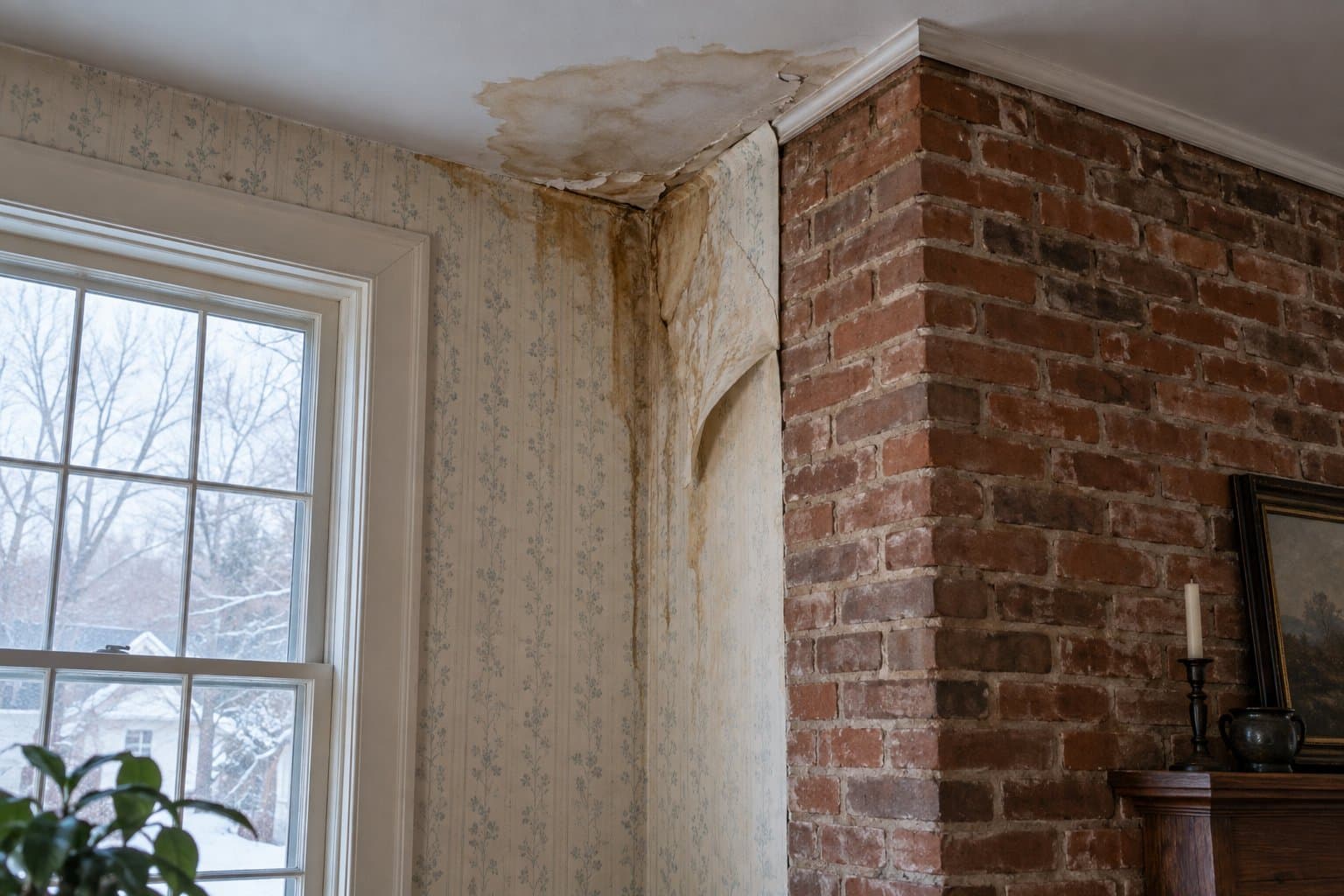
White Plains makes this worse than it would be elsewhere. The climate here is humid continental, with cold winters that bring repeated freeze-thaw cycles. Water soaks into a crack in the crown or a soft mortar joint, freezes, expands, and widens the crack a little more. Then it thaws and does it again. Nor'easters and the remnants of tropical systems bring high wind and heavy rain, and wind-driven rain gets in where ordinary rain just runs past. Add New York's long heating season and masonry that stays damp, and a small opening becomes a real leak in a few seasons.
While you wait — please don't
- Don't seal or paint over the stain. Covering the ceiling hides the evidence while the water keeps running down inside the chimney and the masonry keeps breaking down.
- Stop using the fireplace if the liner may be damaged. Years of water inside a flue can crack tile and break down a liner, and a damaged liner can let heat and combustion gases reach places they should never go.
- Get out and call 911 if anyone feels ill with an appliance running. Headache, dizziness or nausea around a working fireplace or heating appliance can mean carbon monoxide, so leave the house first and call from outside.
- Keep people away from the base of the chimney. A chimney that has been wet for years can become structurally unsound, and falling brick is a hazard at the base.
- Don't go up on the roof to look. Wet masonry and roof work are the technician's job, and a fall costs more than the repair ever would.
What the technician does
- The entry point gets tracedThe technician works out where the water is actually coming in rather than sealing over the obvious spot. Water travels, so the stain and the hole are rarely in the same place.
- Flashing is replaced properlyWhere the chimney meets the roof, new flashing goes in and is counter-flashed into the mortar joint. That detail is what keeps wind-driven rain out over the long run.
- The crown is repaired or recastThe crown is the concrete slab across the top of the chimney, and cracks there let water straight into the brickwork. Depending on how far gone it is, it gets repaired or recast.
- A cap is fittedAn open flue is an open pipe pointed at the sky. A cap keeps rain, snow and falling leaves out of it.
- Repointing and brick replacementFailed mortar joints get raked out and repointed, and brick that has spalled — where the face has flaked off from freezing — gets replaced.
- Breathable water repellent where appropriateOnce the repairs are done, a breathable repellent can be applied to the masonry. It sheds water while still letting the brick dry out, which matters on an older chimney.
Why this happens in in White Plains, NY
Housing in White Plains skews older for the region. Pre-WWII colonials, Tudors and capes sit alongside post-war ranches and splits, and nearly all of them have masonry chimneys. Many of the older homes still have their original brick or stone chimneys, and those commonly need repointing and a liner evaluation before the heating season. Across New York generally, unlined or clay-tile masonry chimneys needing relining are very common in housing of this age, and plenty of those flues are still actively venting oil or older atmospheric gas heat rather than sitting decorative.
The heavy oak and maple canopy over the older White Plains neighborhoods drops leaf litter into gutters and chimney caps every autumn, and a blocked cap holds water right where you don't want it. Demand here spikes twice: in early spring, once freeze-thaw damage from the winter shows up, and again in fall as people get ready for the first cold snap. Exterior masonry work concentrates in the warmer months, because mortar needs to cure without freezing. Chimney work in White Plains typically requires City of White Plains permits, and the technician should know what the job needs before it begins.
Questions people ask
- How do I know it's the chimney and not the roof?
- You often can't tell from inside, because water runs along framing before it shows on a ceiling. A damp patch right beside the chimney breast points at the chimney, but the entry point still has to be traced. Ask the technician to show you where the water is getting in and to put the reasoning in writing.
- Do I need a permit for chimney work in White Plains?
- Work in White Plains typically requires City of White Plains permits, and in New York permits are issued locally by the municipal building department, not by a state agency. Structural masonry work such as rebuilding a chimney above the roofline usually needs one; routine sweeping and inspection generally do not. Call the City of White Plains building department before work begins to confirm.
- Is the contractor licensed?
- New York does not issue a statewide license for chimney sweeping, inspection or masonry repair — it is handled locally. Westchester County runs its own home improvement contractor licensing program, so you can verify current requirements with the county consumer affairs or licensing office. We arrange the work; credentials are the contractor's to show you, and you're entitled to ask.
- Can this be fixed in winter?
- Inspection and tracing the leak can happen year-round, but mortar needs to cure without freezing, so repointing and exterior masonry rebuilding concentrate in the warmer months. In White Plains that means spring through fall for the masonry side. The technician will tell you what can be done now and what should wait.
- Will a water repellent on its own stop the leak?
- Not if the crown is cracked, the flashing has failed or there's no cap. A breathable repellent is applied where appropriate after the actual entry point is dealt with. Sealing the outside of a chimney that is still letting water in at the top just traps moisture in the brick.
One call
One Call Chimney is a referral and scheduling service covering all fifty states — we arrange the work with independent sweeps and masons, and we are not the contractor. Call (866) 576-7943 and we'll set up a free estimate: the technician inspects the chimney and gives you the price before any work starts, and you approve it first.
More from One Call Chimney
Nearby
Answers
Free tool
Something else in this area
- Never been swept
- Smoke comes back into the room
- Something living up there
- Smells of smoke or damp
- Cracked crown or crumbling brick
- Damper stuck or broken
- Liner damaged or missing
- Rebuild or new chimney
One Call Chimney arranges the visit; the technician does the work and gives you the price.