
Water coming in in Troy, NY
A damp patch on the ceiling next to the chimney means water is getting into the chimney, or past it, and running down inside the house. The stain you can see is usually some distance from the actual entry point. Water travels along framing and masonry before it shows up on plaster or drywall. So the wet spot tells you there is a leak, but it does not tell you where the leak is.
Phones answered around the clock · free estimate
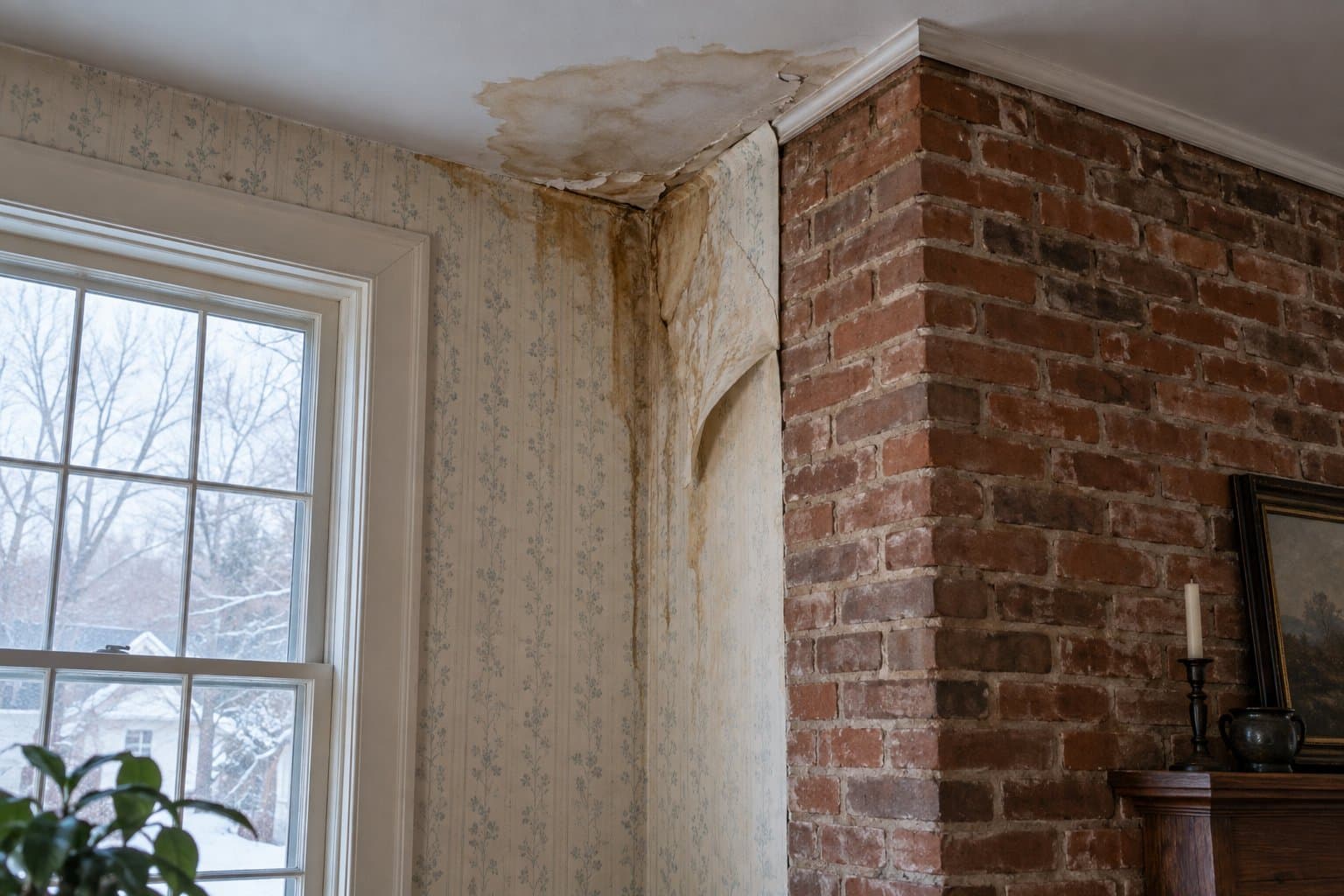
The usual suspects are flashing where the chimney meets the roof, a cracked or worn crown on top, a missing cap letting rain straight down the flue, and open mortar joints or spalled brick in the stack itself. In Troy that last group is common. The city sits inland on the Hudson with cold, snowy winters and frequent freeze-thaw cycles. Water soaks into brick and mortar, freezes, expands, and widens every crack it finds. Troy's housing stock is unusually old for the region, with plenty of 19th- and early-20th-century brick rowhouses and Victorian-era masonry, and New York generally has some of the oldest housing in the country. Old masonry that has been through decades of freeze and thaw leaks.
While you wait — please don't
- Do not just paint over the stain. The water is still coming in behind it, and covering the stain only hides how fast the problem is growing.
- Do not seal the top of the chimney shut. If the flue still vents an appliance, closing it off traps combustion gases, and carbon monoxide can end up in the house.
- Do not stand at the base of a badly deteriorating stack. A chimney that has been wet for years can become structurally unsound, and falling brick is a real hazard at the base.
- Do not keep burning if the flue is soaked or damaged. Water and damaged masonry can mean a compromised liner, so stop using the fireplace until it has been looked at; if anyone feels dizzy, sick or headachy around the appliance, get outside and call 911.
- Do not wait for spring. Every freeze-thaw cycle between now and then makes the crack a little bigger and the repair a little bigger with it.
What the technician does
- The entry point gets tracedThe technician works out where water is actually getting in rather than sealing over the general area. That usually means looking at the roof line, the crown, the cap and the brickwork, not just the ceiling stain.
- Flashing is checked and replacedWhere the chimney meets the roof is the most common entry point. Proper repair means new flashing, counter-flashed into the mortar joint so water cannot track behind it.
- The crown is repaired or recastThe crown is the concrete surface on top of the chimney. Once it cracks, water runs straight down into the masonry, and in a freeze-thaw climate those cracks only get wider.
- A cap is fittedA cap keeps rain and snow out of the open flue. It also keeps animals from getting in, which is a separate problem you would rather not have.
- Repointing and brick replacementOpen mortar joints get raked out and repointed, and spalled brick — brick whose face has flaked off — gets replaced. This is the slow damage that freeze-thaw does to old Troy masonry.
- Breathable water repellent where appropriateOn some chimneys a breathable repellent is applied so the masonry can still dry out while shedding rain. It is used where it suits the chimney, not as a substitute for fixing the actual leak.
Why this happens in in Troy, NY
Troy is roughly 140 miles inland on the Hudson, so there is no salt air to deal with. What you get instead is deep winter cold and repeated freeze-thaw. Moisture gets into a mortar joint in November, freezes, pushes the joint open a little, thaws, soaks in further, and does it again. By spring the joint is wider than it was. That is why damage so often shows up during the spring thaw, and why demand across New York for repointing and masonry work concentrates in the warmer months, when mortar can cure without freezing.
The other Troy factor is the buildings. The Collar City has one of the best-preserved stocks of 19th-century brick and brownstone rowhouses in the Northeast. That means party walls, shared chimney stacks, and masonry that needs repointing after decades of freeze-thaw. On a shared stack, water getting in at the crown can show up in the house next door. Lansingburgh, South Troy, Washington Park, Little Italy and Downtown Troy are full of this kind of masonry, and plenty of these flues are still active venting flues rather than decorative. Wind-driven rain off nor'easters and the remnants of tropical systems gets in where ordinary rain just runs past.
Questions people ask
- The stain is two feet from the chimney. Is the chimney still the cause?
- Often, yes. Water entering at the crown or flashing can run down inside the structure and emerge at a joist or a plaster seam some distance away. That is why the entry point has to be traced rather than guessed at from the stain.
- Do I need a permit for this in Troy?
- In New York, permits are issued locally by the municipal building department and code enforcement officer, not by a state agency. Routine sweeping and inspection generally do not need one, but structural masonry work such as rebuilding a chimney above the roofline typically does. Call the Troy building department before work begins, since thresholds vary between jurisdictions.
- Is there a state chimney licence I should ask about?
- New York does not issue a statewide licence for chimney sweeping, inspection or masonry repair. Licensing or registration is handled at the city or county level, and many upstate municipalities require only local registration or nothing at all. Check current requirements with the city or county consumer affairs or licensing office covering Troy.
- My chimney is shared with the house next door. Does that change anything?
- It can. Shared stacks are common in Troy's rowhouses, and a leak at the top of one stack can affect both sides. The technician will want to see the whole structure, and you may need to talk to your neighbour about access.
- What does an estimate cost?
- Nothing. Every job gets a free estimate — the technician inspects the chimney and gives you the price before any work starts, and you approve it first. If you want the reasoning behind a recommendation, ask for it in writing, and ask to see any camera footage they took.
One call
One call to (866) 576-7943 and we will arrange for an independent sweep or mason to come out and look at the leak. The estimate is free, and the price is agreed with you before any work begins.
More from One Call Chimney
Nearby
Answers
Free tool
Something else in this area
- Smoke comes back into the room
- Never been swept
- Something living up there
- Smells of smoke or damp
- Cracked crown or crumbling brick
- Liner damaged or missing
- Damper stuck or broken
- Rebuild or new chimney
One Call Chimney arranges the visit; the technician does the work and gives you the price.