
Chimney Rebuild in Syracuse, NY
You have looked up and the chimney does not look right. Bricks are flaking or missing, the mortar joints have gone soft or empty, the stack leans, or pieces have landed in the gutter or on the driveway. That is masonry that has taken on water and lost its grip. Once brick and mortar start shedding, the damage does not stop on its own, and the part of the chimney above the roof is usually the part that goes first.
Phones answered around the clock · free estimate
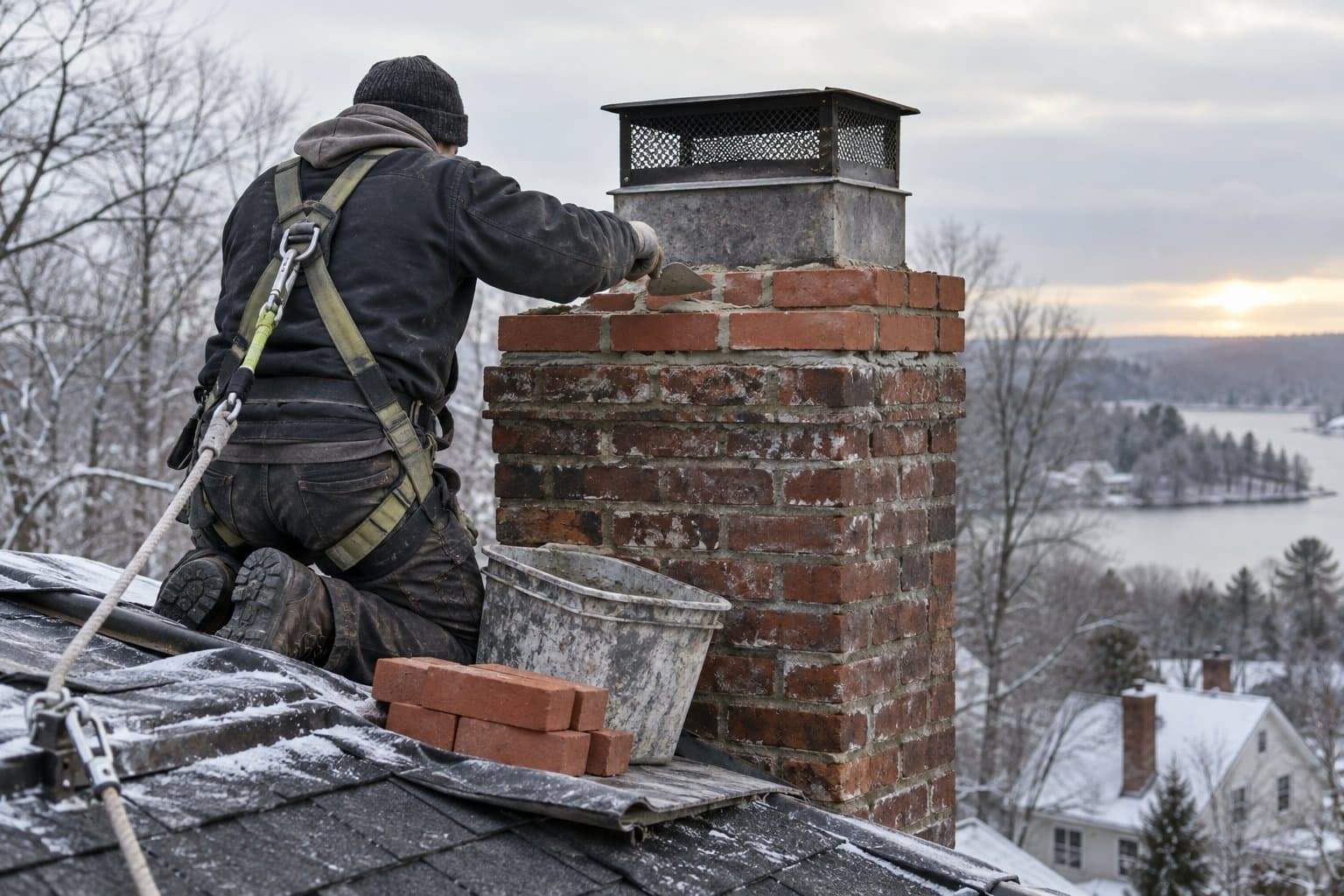
Syracuse is hard on brick. Winters here are long and very snowy, with lake-effect snow off Lake Ontario, and the freeze-thaw cycling that comes with it is the main thing that breaks masonry chimneys apart. Water soaks into brick and mortar, freezes, expands and pops the face off the brick. Much of the city's housing was built before 1940, so a lot of these chimneys are a century old, and century-old brick chimneys around Syracuse commonly show spalling and mortar loss. Long heating seasons keep those flues working almost half the year.
While you wait — please don't
- Stop using the fireplace. A fireplace should not be used under a stack that is leaning or shedding brick, because the flue inside it may no longer be sound.
- Get out and call 911 if you smell smoke indoors or a CO alarm sounds. A failing chimney can let flue gases into the house, and carbon monoxide is not something to investigate from inside.
- Keep people and cars away from the base. Falling brick from a roofline stack lands hard, so move what you can out from under it and stay off that side of the house in wind.
- Do not climb up to look. Syracuse roofs are steep and often icy or snow-loaded in winter, and loose masonry gives way under a hand or a foot.
- Do not patch over crumbling mortar yourself. New mortar smeared over failed joints hides how far the damage has gone and does not hold the stack together.
What the technician does
- Inspection with photographsThe technician looks at the whole chimney and photographs what is failing, so you can see the spalled brick, the open joints and the condition of the crown yourself rather than taking it on description.
- Rebuild above the rooflineThis is the usual answer. The stack is taken down to sound masonry and rebuilt from there, which is where freeze-thaw damage nearly always concentrates.
- Full rebuild where the structure has goneIf the damage runs below the roof, the chimney is rebuilt with a proper footing and new flashing where it meets the roof.
- New crown, cap and linerA new crown and cap go on as part of the work to keep water out of the top, and the liner is addressed at the same time rather than left for later.
- Brick and mortar matchedThe mason matches brick and mortar as closely as the house allows, which matters on the older brick and stone homes common here.
- The price before any workThe technician gives you the price after the inspection and you approve it before anything starts. The estimate is free.
Why this happens in Syracuse, NY
Timing matters in Syracuse. Masonry needs temperatures above freezing to cure, so a rebuild is warm-month work. If your chimney fails in January, the sensible order is an inspection now, a temporary cover over the stack to keep snow and water out, and the rebuild scheduled once the weather allows. That is not a delay for its own sake; mortar laid in the cold will not set properly and you will be doing it twice.
Demand follows the same pattern across the area. It climbs in early fall as people get heating systems and chimneys ready before the snow, and again during the spring thaw when winter damage shows itself. If you are in Eastwood, Tipperary Hill, Westcott, Strathmore or the older wards, or out in DeWitt, Liverpool, Camillus or Baldwinsville, calling early in the season gives you more room in the schedule. Ice dams along the eaves of older steep-roofed homes are a recurring problem here too, and the same water that causes them is what gets into a chimney crown.
Questions people ask
- Do I need a permit to rebuild a chimney in Syracuse?
- In New York, permits are issued locally by the municipal or county building department, not by a state agency. Structural masonry work such as rebuilding a chimney above the roofline typically requires one, and relining as part of an appliance installation usually does too. Call the local building department before work begins, since thresholds vary between jurisdictions.
- Is the whole chimney coming down, or just the top?
- Usually just the part above the roofline, because that is where freeze-thaw damage concentrates. A full rebuild with a new footing is for cases where the structure itself has gone. The inspection photographs are what tell you which one you are looking at.
- Can the rebuild be done in the winter here?
- Masonry needs temperatures above freezing to cure, so Syracuse rebuilds are warm-month work. A temporary cover can protect the stack through the snow until conditions allow the work to be done properly.
- Is there a state chimney license in New York?
- New York does not issue a statewide license for chimney sweeping, inspection or masonry repair; it is handled locally. Some downstate counties run home improvement contractor licensing programs, while many upstate municipalities require only local registration or nothing at all. Verify current requirements with the city or county licensing office where the work will be done.
- What should I ask for before I agree to the work?
- Ask to see the inspection photographs of what is failing, and ask for the reasoning in writing — why the stack is coming down to that point and what goes back on top. You get the price before any work starts and you approve it first.
One call
One call to (866) 576-7943 and we arrange the inspection with an independent sweep or mason — we schedule the work, we are not the contractor. The estimate is free, and the technician gives you the price before anything starts, for you to approve first.
Something else in this area
- Never been swept
- Smoke comes back into the room
- Water coming in
- Something living up there
- Smells of smoke or damp
- Damper stuck or broken
- Cracked crown or crumbling brick
- Liner damaged or missing
One Call Chimney arranges the visit; the technician does the work and gives you the price.