
Cracked crown or crumbling brick in Niagara Falls, NY
The crown is the slab across the top of the chimney. It sheds rain away from the brick and the flue. When it cracks, water runs straight down into the masonry instead. After that you start seeing the signs you probably called about: brick faces flaking off, pieces of mortar in the gutter, chunks on the driveway or in the flower bed, white staining on the stack, maybe a gap at the corner where the brick has pulled apart.
Phones answered around the clock · free estimate
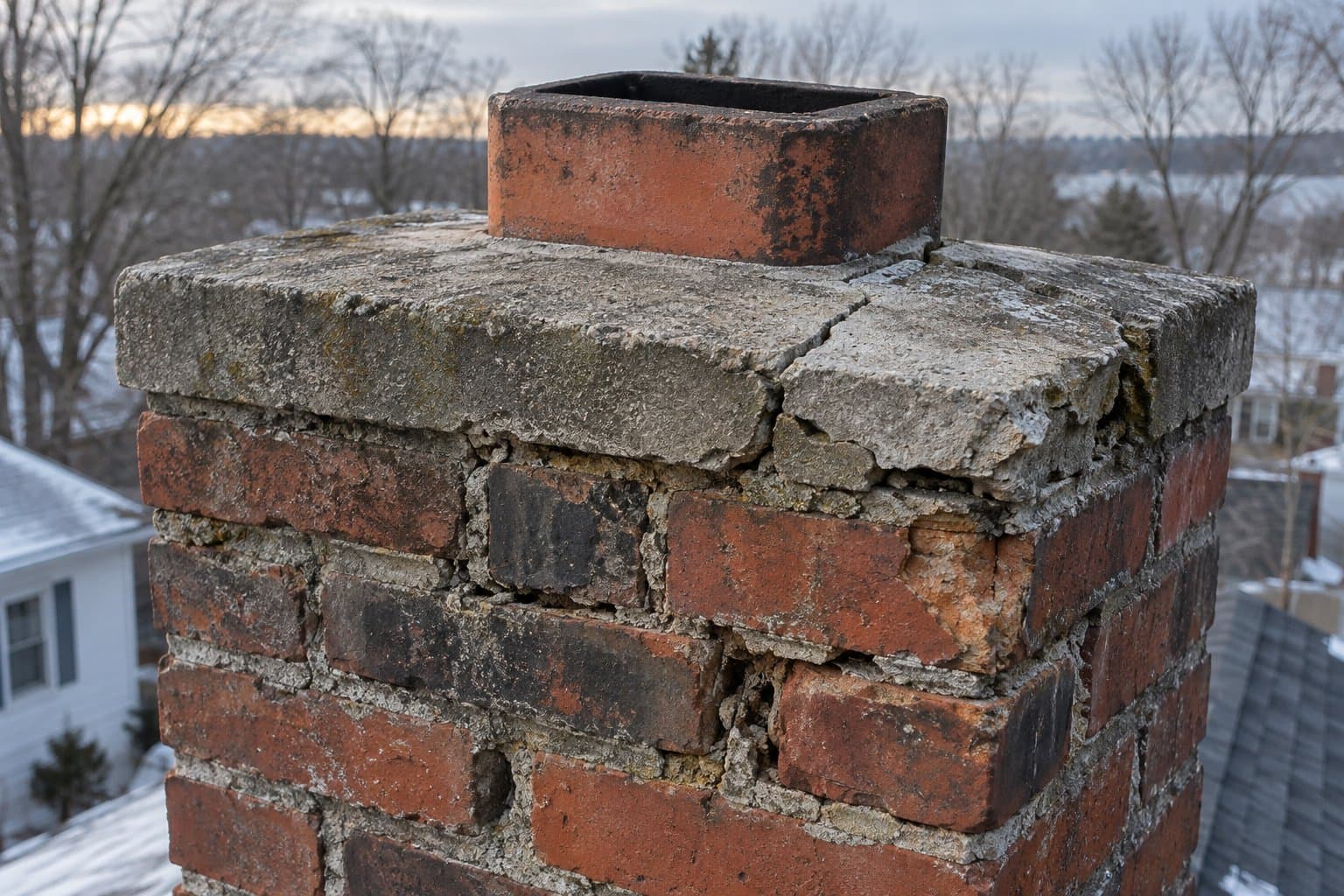
This happens fast in Niagara Falls because of the weather. Lake-effect snow off Erie and Ontario keeps the stack wet, and freeze-thaw cycles run from November into March. Water soaks into a hairline crack, freezes, expands, and widens it. Then it thaws and goes deeper. Do that a few dozen times a winter and a crack becomes a rebuild. A lot of the housing here was built between the early 1900s and the 1960s, with masonry chimneys left from the coal and oil heating days, and those stacks have been through a lot of winters already.
While you wait — please don't
- Keep people away from the base of the chimney. Falling brick is a real hazard at ground level, so move cars, bins and anything you walk past daily out from under the stack.
- Don't go up on the roof to look. Icy or snow-loaded roofs are no place to be, and a loose stack can shift when you lean on it.
- Stop burning if the stack is leaning or open at the joints. Once the masonry has lost structure, the flue inside it may be compromised too, and that is a safety issue rather than a cosmetic one.
- Stop using the fireplace if smoke comes into the room. Smoke backing up means the flue is not venting as it should, and if anyone feels dizzy, sick or headachy, get everyone outside and call 911.
What the technician does
- A look at the whole stack, not just the crackThe technician checks the crown, the mortar joints, the brick faces and the flue, from the roofline up. The point is to find out how far the water has already travelled.
- The crown repaired or recastMinor cracks can sometimes be sealed. Where the slab has failed, it gets recast with an overhang and a drip edge so rain is thrown clear of the brick instead of running down it.
- Repointing the open jointsFailed mortar is cut out and replaced, matched to the existing work. That closes the path water has been using to get into the stack.
- Spalled brick cut out and replacedBrick with the face popped off will not hold up to another freeze season. Those units are cut out and new ones set in.
- A cap fittedA cap keeps rain and snow out of the flue itself, which matters on the older oversized masonry chimneys common around here.
- Rebuild above the roofline where neededIf the stack has lost structure or is leaning, the section above the roof is taken down and rebuilt. The technician explains why before anything is touched.
Why this happens in Niagara Falls, NY
Niagara Falls homes tend to be detached, wood-frame with vinyl or aluminum siding, some brick and stucco, with full basements and a masonry chimney that was originally built for coal or oil heat. Plenty of those stacks are still standing in Downtown, LaSalle, DeVeaux and the North End long after the appliance they served was replaced. When a house switches to a high-efficiency gas furnace, the old oversized flue often ends up unused or needing capping, and an uncapped flue takes on water all winter. That water is what feeds the freeze-thaw damage you see at the top.
Timing matters with masonry. Across New York, exterior rebuilding and repointing concentrate in the warmer months, because mortar needs to cure without freezing. Locally, damage tends to show itself twice a year: in late fall when people get the chimney ready for the heating season, and again during the spring thaw when the winter's freeze-thaw work becomes visible. If you are seeing brick on the ground now, it is worth getting eyes on it rather than waiting for the next round of lake-effect storms to open the cracks further.
Questions people ask
- Can the crown just be sealed instead of recast?
- Sometimes, if the cracking is minor and the slab is otherwise sound. Where the crown has broken up or has no overhang, recasting with a drip edge is what keeps water off the brick. The technician will tell you which case yours is, and you can ask for the reasoning in writing.
- Do I need a permit for chimney masonry work in Niagara Falls?
- In New York, permits are issued locally by the municipal or county building department, not by a state agency. Structural masonry work such as rebuilding a chimney above the roofline typically needs one, while routine sweeping and inspection generally do not. Call your local building department before work begins, since thresholds vary between jurisdictions.
- Is there a state chimney licence I should ask about?
- New York does not issue a statewide licence for chimney sweeping, inspection or masonry repair; the work is regulated locally. Some downstate counties and New York City run their own home improvement contractor programs, and many upstate municipalities require only local registration. You can verify current requirements with the city or county licensing office where the work will be done.
- Why does the brick here crumble faster than I expected?
- Repeated freeze-thaw cycles are hard on crowns, mortar joints and brick faces, especially once masonry has absorbed moisture. Niagara Falls gets heavy snowfall and those cycles are normal from November into March. A stack that looked fine two winters ago can lose its face in one bad season.
- Does One Call Chimney do the repair?
- No. We are a referral and scheduling service that arranges chimney work with independent sweeps and masons across all fifty states, and we are not the contractor. The technician who comes out does the inspection and the work.
One call
One call to (866) 576-7943 and we arrange for a technician to come out, inspect the chimney and give you a free estimate. Nothing starts until you have seen the price and approved it.
More from One Call Chimney
Nearby
Answers
Free tool
Something else in this area
- Smells of smoke or damp
- Damper stuck or broken
- Liner damaged or missing
- Smoke comes back into the room
- Rebuild or new chimney
- Never been swept
- Water coming in
- Something living up there
One Call Chimney arranges the visit; the technician does the work and gives you the price.