
Water coming in in Rochester, NY
You have a damp patch on the ceiling next to the chimney, or a stain running down the wall above the firebox. Water is getting into the chimney somewhere above, then travelling down inside the structure until it finds a way out. The wet spot you can see is almost never directly under the hole. That is the part people get wrong, and it is why sealing the stain from below does nothing.
Phones answered around the clock · free estimate
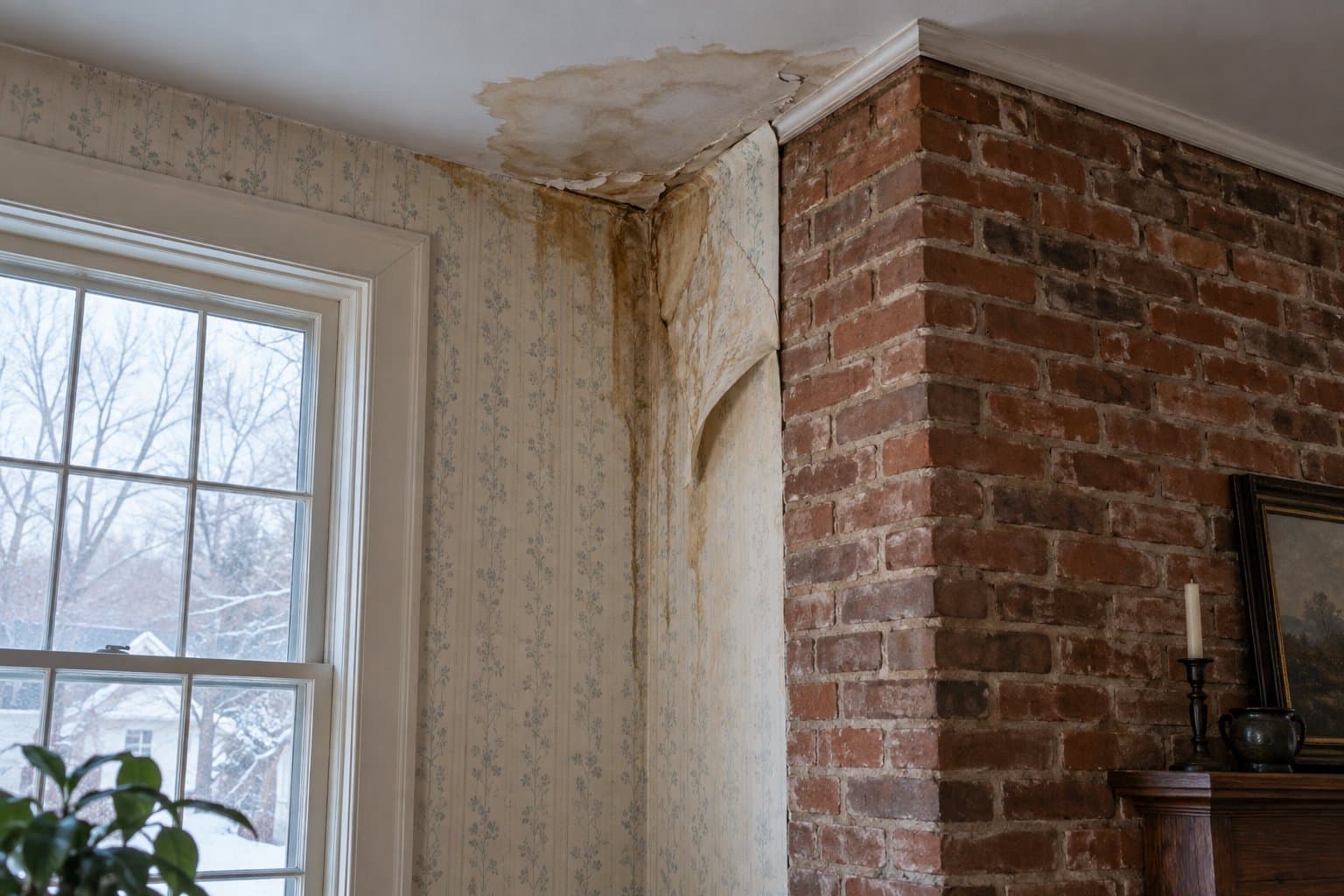
There are only a handful of places the water is likely coming in: the crown at the top, a missing or ill-fitting cap, the flashing where the chimney meets the roof, or the brick and mortar joints themselves. In Rochester that last one matters a lot. Rochester winters bring long stretches below freezing and heavy lake-effect snow off Lake Ontario, and across New York those repeated freeze-thaw cycles are hard on crowns, mortar joints and brick faces — especially once a flue has already absorbed moisture. Freeze and thaw widens every crack it finds, and wind-driven rain gets in where ordinary rain would simply run past.
While you wait — please don't
- Do not smear sealant over the stain. Covering the patch inside hides the evidence and leaves the water still running through the brickwork above.
- Do not paint or seal the chimney with a waterproof coating. A non-breathable coating traps moisture inside the masonry, and trapped water freezing in a Rochester winter does more damage than the leak did.
- Stay clear of the base of the chimney outside. A chimney that has been wet for years can become structurally unsound, and falling brick is a hazard at the base.
- Do not light a fire to dry it out. If water has been sitting in the flue you may not know the condition of the liner, so leave the fireplace alone until someone has looked inside it.
- Do not go up on a snowy or iced roof to look. Roof work in a Rochester winter is not worth a broken back, and the entry point usually needs a close look anyway, not a glance from a ladder.
What the technician does
- The entry point is traced, not guessedThe technician works out where the water is actually getting in rather than sealing over the place where it shows up inside. That means looking at the crown, the cap, the flashing and the masonry as separate suspects.
- Flashing replaced and counter-flashedWhere the roof meets the chimney, new flashing is fitted and counter-flashed into the mortar joint so water is shed rather than led inward. This is one of the most common sources of a ceiling stain beside a chimney.
- Crown repaired or recastA cracked crown lets water straight down into the chimney structure. Depending on condition it is repaired or recast so it sheds water clear of the brick.
- Cap fittedA cap keeps rain and snow out of the flue opening itself. It also keeps animals from going down it.
- Repointing and spalled brick replacedOpen mortar joints and brick faces that have crumbled from freeze-thaw are cut out and replaced. On older Rochester masonry this is often where the water is soaking in.
- Breathable water repellent where appropriateOnce the repairs are sound, a breathable repellent can slow absorption without trapping moisture in the brick. It is applied where it suits the masonry, not as a substitute for repair.
Why this happens in in Rochester, NY
Much of Rochester's housing stock predates 1940 — wood-frame Victorians, foursquares, colonials and bungalows, plus a substantial amount of brick. Many of those homes still have their original masonry chimneys and fireplaces, and those are exactly the chimneys that need periodic crown and liner inspection. Across upstate New York, unlined or clay-tile masonry flues are very common, and water is hard on both. If you are in Park Avenue, Corn Hill, the South Wedge, Browncroft or the 19th Ward and the chimney has never been looked at closely, a leak is often the first sign that the crown or the mortar has gone.
Timing matters here. Repointing and masonry rebuilding concentrate in the warmer months, because mortar needs to cure without freezing. So a leak found in February may get a temporary answer first and the masonry work scheduled when conditions allow — the technician can explain what is safe to defer and what is not. Demand for chimney work in Rochester spikes in late fall before the first hard freeze and again during January and February lake-effect snow, and again at the spring thaw when water that has been sitting in the brickwork all winter finally shows itself on a ceiling.
Questions people ask
- Why is the stain not directly under the leak?
- Water that gets in at the crown or the flashing runs down inside the chimney structure until it meets something that stops it — a joist, a flue tile, a bend in the masonry. It then emerges wherever that is. Tracing the entry point is the first job, and it is why sealing the visible patch is not a repair.
- Can this wait until spring?
- That depends on how long it has been going on and what the masonry looks like now. A chimney that has been wet for years can become structurally unsound, and falling brick is a hazard at the base. Get it inspected, then decide with the technician what has to happen now and what can wait for mortar weather.
- Do I need a permit in Rochester?
- Permits for chimney work in New York are issued locally by the municipal or county building department, not by a state agency. Routine sweeping and inspection generally do not need one, but structural masonry work such as rebuilding a chimney above the roofline typically does. Call your local building department before work begins, since thresholds vary between jurisdictions.
- Is the chimney sweep licensed by New York State?
- New York does not issue a statewide licence for chimney sweeping, inspection or masonry repair — it is handled locally, and many upstate municipalities require only local registration or nothing at all. You can verify current requirements with the city or county consumer affairs or licensing office. You are free to ask any technician directly about their own credentials and insurance.
- What should I ask for during the inspection?
- Ask to see the camera footage if the flue is scoped, and ask for the reasoning in writing — which entry point was found, and why the proposed repair addresses it. A good written explanation makes it easy to understand what you are approving.
- What does One Call Chimney actually do?
- We are a referral and scheduling service that arranges chimney work with independent sweeps and masons across all fifty states, including Rochester and nearby towns like Brighton, Irondequoit, Greece and Penfield. We are not the contractor and we do not perform the work ourselves. We arrange the visit and the technician handles the inspection and the repair.
One call
Call (866) 576-7943 and we will arrange for an independent technician to come out, find where the water is getting in, and give you the price before any work starts. The estimate is free on every job, and nothing happens until you approve it.
Something else in this area
- Something living up there
- Smoke comes back into the room
- Smells of smoke or damp
- Liner damaged or missing
- Never been swept
- Rebuild or new chimney
- Cracked crown or crumbling brick
- Damper stuck or broken
One Call Chimney arranges the visit; the technician does the work and gives you the price.