
Chimney Rebuild in Rochester, NY
You have looked up and the chimney does not look right. Maybe the brick is flaking, the mortar joints are soft or gone, the stack leans a little, or you have found pieces of brick in the yard or the gutter. That usually means the masonry has taken on water and freezing has broken it apart from the inside. Once brick starts shedding, the damage does not stop on its own.
Phones answered around the clock · free estimate
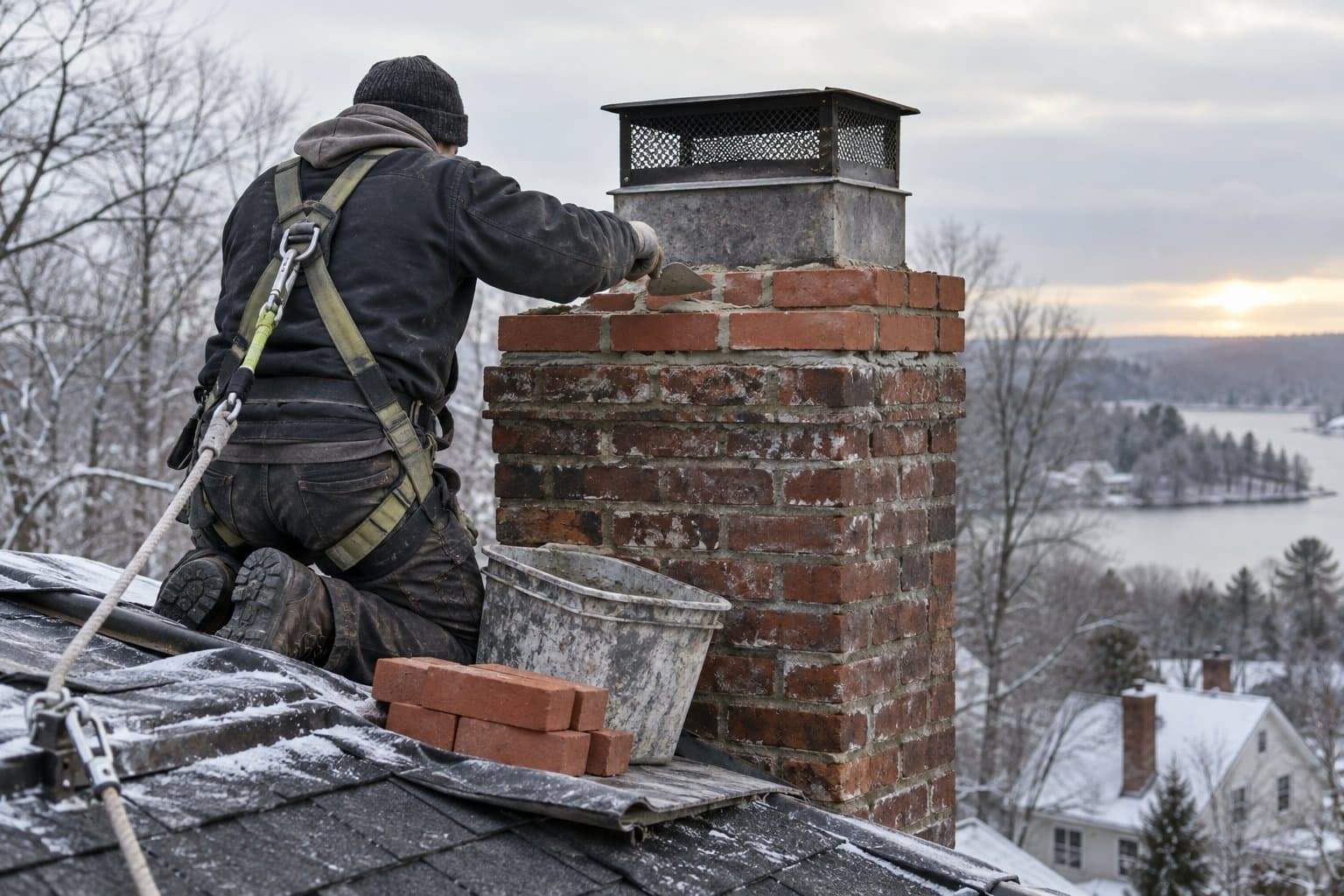
Rochester is hard on masonry. Winters are cold and snowy, with long stretches below freezing and heavy lake-effect snow off Lake Ontario, and repeated freeze-thaw cycles work on chimney crowns, mortar joints and brick faces all season. Summers here are humid, which keeps an unused flue damp. Much of the city's housing stock predates 1940 — Victorians, foursquares, colonials and bungalows — and many of those homes still have their original masonry chimneys, some with undersized or unlined flues. A stack that has stood for eighty or ninety Rochester winters has absorbed a lot of water.
While you wait — please don't
- Stop using the fireplace. A fireplace should not be used under a stack that is leaning or shedding brick, because the flue inside may already be broken open.
- Get out and call 911 if you feel unwell. Headache, nausea, dizziness or drowsiness while an appliance is running can mean carbon monoxide — leave the house and call 911 from outside.
- Keep people and cars clear of the base. Loose brick and crown fragments fall straight down, so move anything you care about out from under the stack.
- Do not patch over the problem. Sealing or skim-coating a failing stack hides what is happening and can trap more water in the brick.
- Do not wait out the winter to look at it. Every freeze-thaw cycle takes a little more mortar, so an inspection now tells you whether the stack is safe to leave standing until spring.
What the technician does
- Inspection with photographsThe technician inspects the chimney and photographs what is failing — the crown, the joints, the brick faces, the flashing and the flue. You should be able to see the pictures yourself.
- The price before any workYou get a price after that inspection and before anything is touched. You approve it first.
- Rebuild above the rooflineThis is the usual answer. The stack is taken down to sound masonry and rebuilt from there, which handles most weather-driven damage without disturbing the rest of the chimney.
- Full rebuild where the structure has goneIf the damage runs below the roof or the chimney is no longer sound at the base, a full rebuild with proper footing and flashing is the fix.
- New crown, cap and linerA new crown and cap go on as part of the work, and a liner is included where the flue needs one. That is what keeps water out of the new masonry.
- Matching the brick and mortarBrick and mortar are matched as closely as the house allows, which matters on Rochester's older brick homes where the original material is no longer made.
Why this happens in Rochester, NY
Timing matters here. Masonry needs temperatures above freezing to cure, so in a cold region like Rochester rebuild work is warm-month work. If your stack fails in January during a lake-effect stretch, the sensible order is inspection first, a temporary cover over the stack to keep snowmelt out, and the rebuild scheduled once the weather allows. Across New York, exterior masonry rebuilding and repointing concentrate in the warmer months for exactly that reason, so booking early in the season is worth doing.
Older Rochester houses often have a chimney that is still an active venting flue rather than a decorative one. Oil-fired and older atmospheric gas heating remain common enough in New York that the same stack may be carrying combustion gases from your heating system, not just smoke from the fireplace. That changes how urgent a failing chimney is. Whether you are in Park Avenue, the South Wedge, Corn Hill, the 19th Ward, Browncroft or out in Irondequoit, Brighton, Greece or Pittsford, the inspection should tell you what the chimney is currently venting and whether it is safe to keep running.
Questions people ask
- Can the chimney be rebuilt in a Rochester winter?
- Usually not. Mortar needs temperatures above freezing to cure properly, and Rochester spends long stretches below that. The practical route is to inspect now, cover the stack temporarily and rebuild in the warmer months.
- Do I need a permit for this in Rochester?
- In New York, permits are issued locally by the municipal or county building department, not by a state agency. Structural masonry work such as rebuilding a chimney above the roofline typically does require one. Call the local building department before work begins.
- Does a partial rebuild really solve it?
- Often, yes. Most weather damage on Rochester chimneys is concentrated above the roofline where the brick is fully exposed to freeze-thaw, snow and rain. A full rebuild with proper footing is for cases where the structure below has gone too.
- Is the chimney sweep or mason licensed?
- New York does not issue a statewide license for chimney sweeping, inspection or masonry repair — it is handled locally, and upstate municipalities vary. Verify current requirements with the city or county consumer affairs or licensing office where the work will be done.
- How do I know the rebuild is the right call?
- Ask to see the inspection photographs and ask for the reasoning in writing. You should be able to look at the same images the technician did and understand why a rebuild was recommended over a repair.
One call
One Call Chimney is a referral and scheduling service — we arrange the work with independent sweeps and masons across all fifty states, and we are not the contractor. Call (866) 576-7943 for a free estimate: the technician inspects the chimney and gives you the price before any work starts, and you approve it first.
Something else in this area
- Water coming in
- Something living up there
- Smoke comes back into the room
- Smells of smoke or damp
- Liner damaged or missing
- Never been swept
- Cracked crown or crumbling brick
- Damper stuck or broken
One Call Chimney arranges the visit; the technician does the work and gives you the price.