
Cracked crown or crumbling brick in New Rochelle, NY
You have looked up and the top of the chimney is cracked. Maybe there are brick chips in the gutter, on the roof, or in the flower bed. That slab on top of the stack is the crown. It is meant to shed water away from the brick and the flue. Once it splits, water runs straight into the masonry instead of off it.
Phones answered around the clock · free estimate
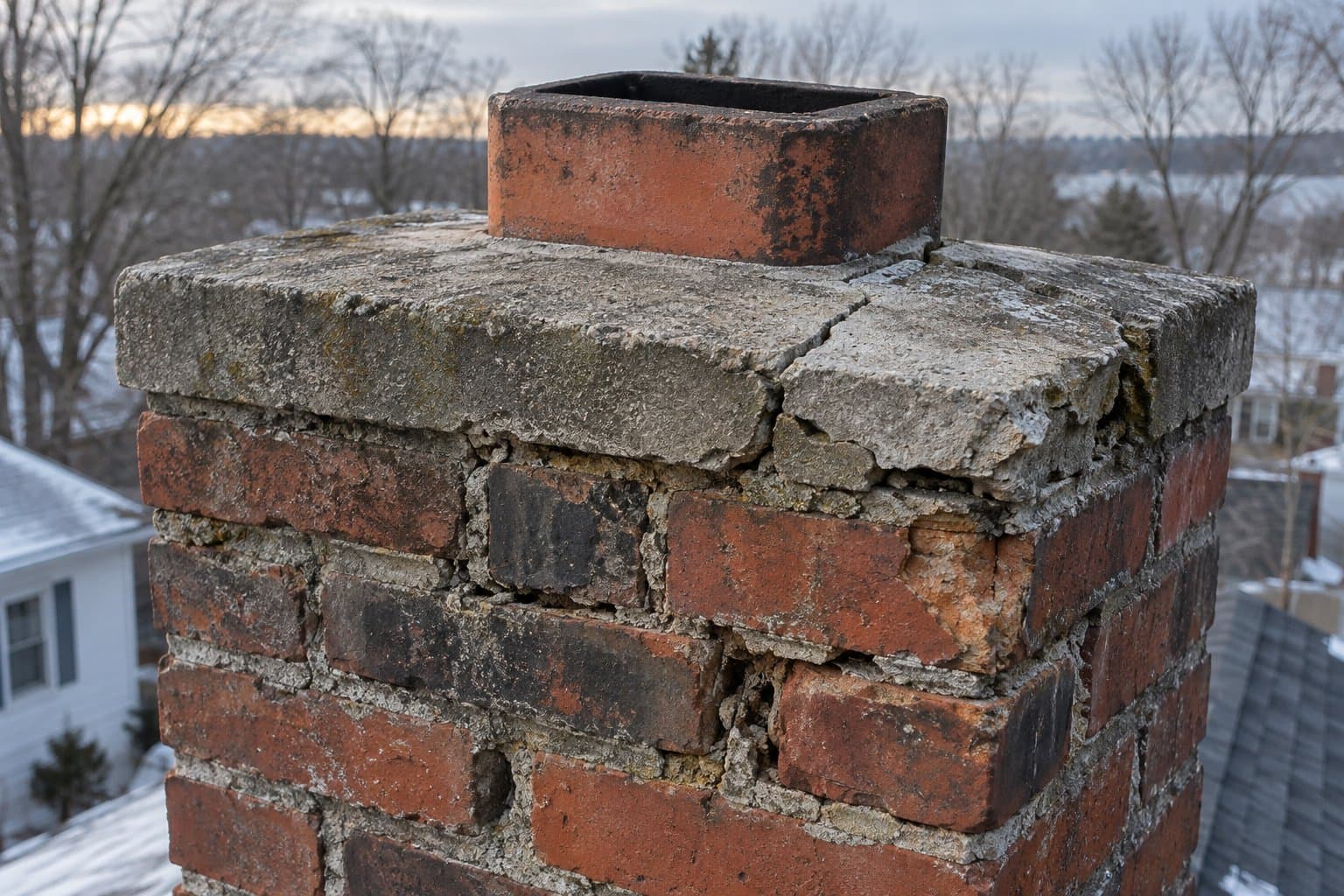
In New Rochelle that water does not just sit there. Winters here bring repeated freeze-thaw cycles, and every time the soaked brick and mortar freeze, the water expands and pushes the material apart. That is how a hairline crack in the crown becomes a face of brick flaking off, and how a flaking face becomes a stack that has to be rebuilt. If your house is near the Sound — Davenport Neck, Premium Point, Sutton Manor, the Echo Bay side — salt-laden air and high humidity work on the cap and the flashing at the same time.
While you wait — please don't
- Keep people away from the base of the chimney. Loose brick falls without warning, so move cars, bins and anything you walk past daily out from under that side of the house.
- Do not go up on the roof to look. Crumbling masonry is unstable to lean on and roofs in winter are slick with ice and snow, so leave the inspection to the technician.
- Stop using the fireplace if the stack is leaning or has open gaps. When the structure has opened up, flue gases can escape where they should not, and that is a safety problem rather than a cosmetic one.
- Treat smoke in the room or a CO alarm as an emergency. If smoke comes back into the house or a carbon monoxide alarm sounds, get everyone outside first and call 911 — then deal with the chimney.
What the technician does
- A look at the whole stack, not just the crackThe technician checks the crown, the brick faces, the mortar joints, the cap and the flashing. The point is to find out how far the water has already travelled.
- The crown repaired or recastA failed crown is repaired or poured again with an overhang and a drip edge so rain drops clear of the brick instead of running down it.
- Repointing matched to the existing workOpen and eroded joints are cut out and repointed, matched to the existing masonry so the repair sits in with the rest of the chimney.
- Spalled brick cut out and replacedBrick that has lost its face is removed and replaced. Patching over a spalled brick does not hold, because the damage is in the brick itself.
- A cap fittedA cap keeps rain, snow and debris out of the flue, which slows down the soaking and freezing that caused the damage in the first place.
- Rebuild above the roofline where neededIf the stack has lost structure, is leaning, or has gaps running through it, the section above the roof is taken down and rebuilt.
Why this happens in New Rochelle, NY
New Rochelle's housing stock is largely pre-1960 — 1920s to 1950s colonials, Tudors and brick or stucco homes in the North End, Rochelle Heights, Residence Park, Wykagyl and along the shore. Masonry chimneys and wood-burning or converted fireplaces are widespread in those pre-war houses, and many of those stacks have been through a lot of winters. New York State as a whole has some of the oldest housing in the country, and crowns, mortar joints and brick faces are usually what give out first when a flue has been absorbing moisture.
Timing matters here. Nor'easters and the remnants of Atlantic tropical systems drive wind and water into the masonry, and demand climbs again at the first hard freeze when chimneys get their first real test of the season. Exterior masonry work concentrates in the warmer months across New York, because mortar needs to cure without freezing. If you are seeing cracks now, it is worth having the chimney looked at before the next cold stretch rather than after.
Questions people ask
- Is a cracked crown urgent, or can it wait?
- The crack itself is usually not an emergency, but the water getting in behind it is what does the real damage. Each freeze-thaw cycle widens what is already there. A leaning stack or one with open gaps through the masonry is structural, and that should be looked at promptly.
- Do I need a permit for chimney masonry work in New Rochelle?
- In New York, permits are issued locally by the municipal building department and code enforcement officer, not by a state agency. Structural masonry work such as rebuilding a chimney above the roofline typically requires one, while routine sweeping and inspection generally do not. Call the local building department before work begins.
- Is there a state chimney licence I should ask about?
- New York does not issue a statewide licence for chimney sweeping, inspection or masonry repair. Westchester County runs its own home improvement contractor licensing program, so you can verify current requirements with the county consumer affairs or licensing office. Code questions go to the local building department or the NYS Department of State Division of Building Standards and Codes.
- Why does my chimney look worse than my neighbour's inland?
- Homes fronting Long Island Sound deal with salt-laden air and high humidity, which accelerates rust on chimney caps and flashing. Combine that with New Rochelle's freeze-thaw winters and the masonry takes a harder beating near the water than it does further from the shoreline.
- How do I know whether it needs repointing or a rebuild?
- That comes down to how much structure the stack has lost, which the technician assesses on site. Ask to see photos of what they found and ask for the reasoning in writing, so you can see why a recast crown is enough or why the section above the roof needs rebuilding.
One call
One Call Chimney is a referral and scheduling service — we arrange the work with independent sweeps and masons and are not the contractor. Call (866) 576-7943 and we will set up a free estimate: the technician inspects the chimney and gives you the price before any work starts, and you approve it first.
More from One Call Chimney
Nearby
Answers
Free tool
Something else in this area
- Smoke comes back into the room
- Never been swept
- Water coming in
- Something living up there
- Smells of smoke or damp
- Damper stuck or broken
- Liner damaged or missing
- Rebuild or new chimney
One Call Chimney arranges the visit; the technician does the work and gives you the price.