Something living up there in White Plains, NY
You hear scratching, fluttering or chirping behind the damper. That is almost always an animal or a bird that has come down an open flue and cannot climb back out. Birds nest on the smoke shelf. Squirrels and raccoons fall in and get stuck. Either way, there is now nesting material, droppings and debris sitting inside a flue that is meant to stay clear.
Phones answered around the clock · free estimate
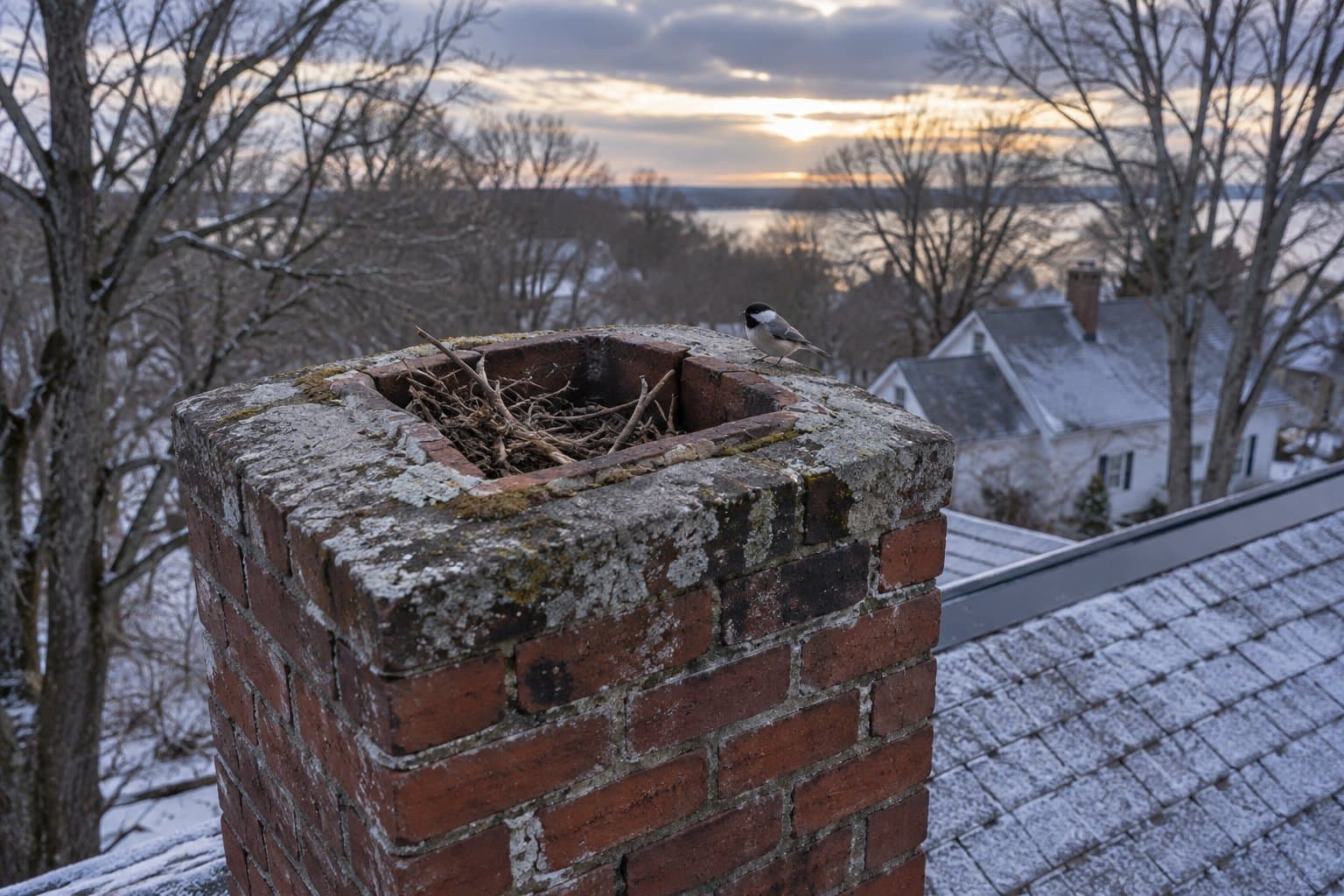
The reason is nearly always a missing or damaged chimney cap. White Plains sits inland in Westchester County, and the heavy mature oak and maple canopy over the older neighborhoods drops leaf litter into caps and flues every autumn. Nor'easters and the remnants of tropical storms bring high wind and downed limbs that knock caps loose. Add repeated freeze-thaw cycles working on crowns and mortar joints, and an older masonry chimney here can end up with an open top long before anyone notices.
While you wait — please don't
- Do not light a fire to drive it out. It is cruel, and burning nesting material packed into a flue is a common cause of chimney fires.
- Do not use the fireplace at all until it is cleared. A nest is a blockage, and a blocked flue can push smoke and carbon monoxide back into the room instead of up and out.
- Get outside and call 911 if anyone feels sick. Headache, nausea, dizziness or confusion around a fireplace can mean carbon monoxide, and that is an emergency, not a wait-and-see.
- Do not reach in or handle droppings yourself. Droppings carry disease, and in many places nesting birds are legally protected, so the species needs to be identified before anything is moved.
- Do not open the damper to look. An animal that drops into the firebox can get loose in the house, and the debris above it will come down with it.
What the technician does
- The animal is identified firstNothing is removed until the technician knows what is up there. Birds, squirrels and raccoons each call for a different approach, and some nesting birds are protected.
- Removal or humane evictionThe animal is removed, or evicted humanely where that is the right method. Where the species requires it, a wildlife specialist is brought in.
- Nesting material and debris taken outTwigs, leaves, droppings and packed nesting material are cleared from the smoke shelf and flue. That is the fire hazard, and it has to come out.
- The flue is sweptOnce the obstruction is gone, the flue is swept so the full length is clear from the firebox to the top.
- The chimney is inspectedThe technician checks the flue, liner, crown and the top of the chimney. Animals get in because something is open, and that gets looked at properly.
- A properly sized cap with mesh is fittedA cap sized to your flue with mesh keeps birds and animals out and keeps leaf litter from dropping in. It is the only thing that stops this happening again.
Why this happens in White Plains, NY
Spring is the peak. That is nesting season, and an uncapped flue is the whole cause. In White Plains, where the housing stock skews older for the region — pre-WWII colonials, Tudors and capes alongside post-war ranches and splits, nearly all with masonry chimneys — original brick and stone chimneys are common, and crowns and mortar joints take a beating from the freeze-thaw cycles every winter. A crown that has cracked or a cap that has shifted leaves a straight route into the flue.
The other busy stretch is fall, when people here are getting chimneys and heating systems ready before the first cold snap. That is often when a nest from the spring is discovered, still sitting on the smoke shelf. In New York, many chimneys are still active venting flues for oil or older atmospheric gas heating rather than decorative, so a blockage is not only a fireplace problem. If your chimney vents a heating appliance, say so when you call so the technician checks that flue as well.
Questions people ask
- I can hear birds but nothing has come down. Is that still urgent?
- Treat it as a blockage. Nesting material builds up fast and sits directly in the path of smoke and flue gases. Stop using the fireplace until the flue has been cleared and inspected.
- Can the nest just be left if I don't use the fireplace?
- It still needs to come out. Dry nesting material in a flue is a fire hazard the moment anyone lights a fire, and droppings carry disease. It also traps moisture, which is hard on an older masonry chimney through a White Plains winter.
- Do I need a permit for this in White Plains?
- Permits in New York are issued locally by the municipal building department and code enforcement officer, not by a state agency, and routine sweeping and inspection generally do not require one. Work in White Plains typically requires City of White Plains permits where it goes beyond that, such as structural masonry work. Call the local building department before work begins if you are unsure.
- Is there a state chimney sweep license in New York?
- New York does not issue a statewide license for chimney sweeping, inspection or masonry repair. Licensing is handled locally, and Westchester County runs its own home improvement contractor licensing program. You can verify current requirements with the county consumer affairs or licensing office.
- I live in a downtown condo. Does that change anything?
- Downtown White Plains is unusually dense for Westchester, with a large share of mid- and high-rise condo and apartment buildings and townhouse developments that carry HOA or condo-board rules. Check what your board requires before scheduling, since access to the roof and the chimney top is often controlled.
- Will a cap really keep them out?
- A cap sized correctly for your flue, with mesh, is what keeps birds and animals out and keeps leaf litter from the oak and maple canopy out of the flue. The technician checks the fit against the flue and the condition of the crown underneath it.
One call
One Call Chimney is a referral and scheduling service — we arrange the work with independent sweeps and masons and we are not the contractor. Call (866) 576-7943, the technician inspects the chimney and gives you the price before anything starts, and nothing happens until you approve it.
More from One Call Chimney
Nearby
Answers
Free tool
Something else in this area
- Never been swept
- Smoke comes back into the room
- Water coming in
- Smells of smoke or damp
- Cracked crown or crumbling brick
- Damper stuck or broken
- Liner damaged or missing
- Rebuild or new chimney
One Call Chimney arranges the visit; the technician does the work and gives you the price.