
Stop using the fireplace
Liner damaged in White Plains, NY
Someone has looked up your flue and told you the liner is cracked. In a masonry chimney that liner is usually clay tile. It is the layer that keeps heat and combustion gases inside the flue and away from the wood framing of your house. When tiles crack, shift or fall apart, that separation is gone.
Phones answered around the clock · free estimate
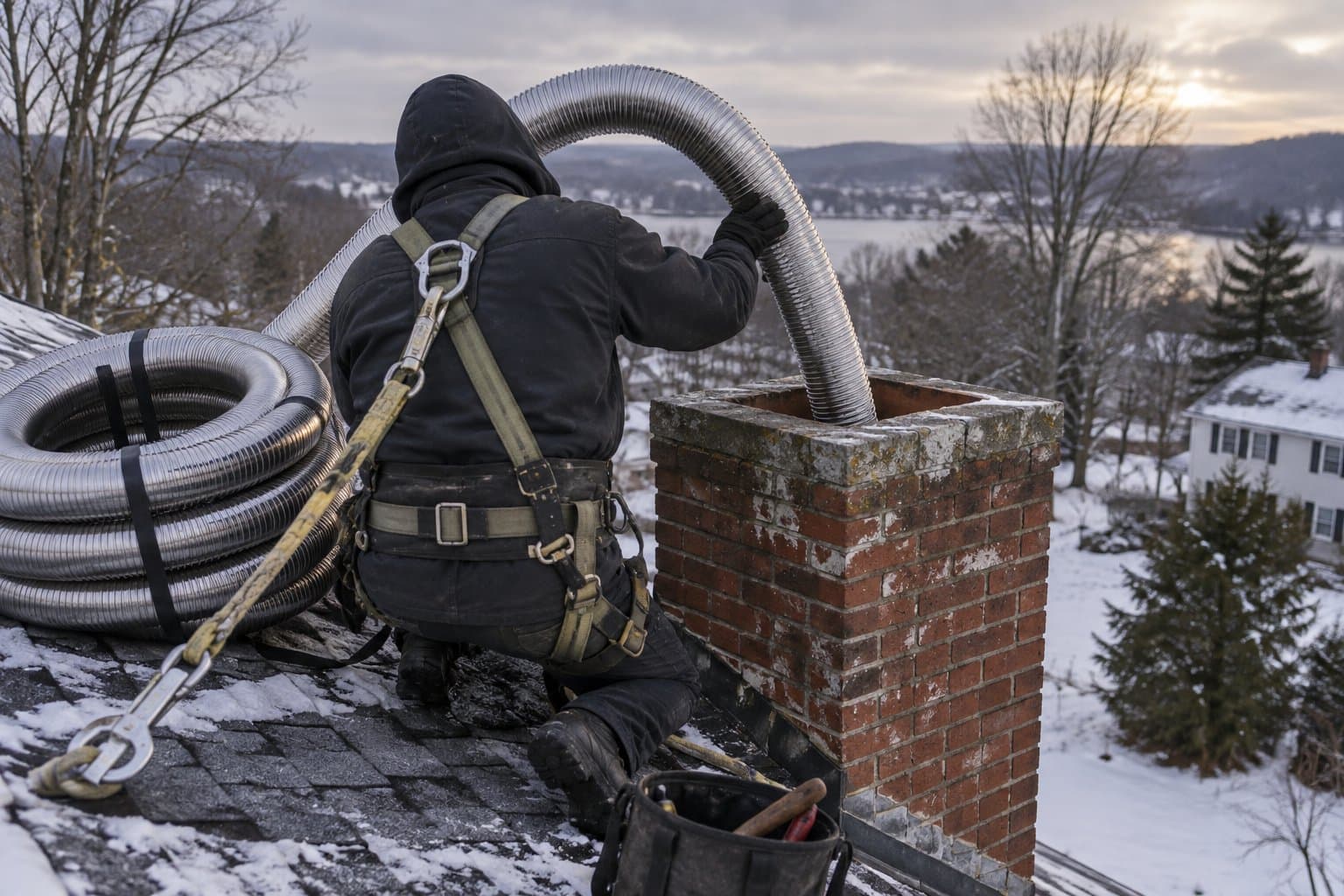
This is common in White Plains. Much of the housing here is older for the region — pre-WWII colonials, Tudors and capes, along with post-war ranches and splits, nearly all with masonry chimneys. New York has some of the oldest housing stock in the country, and unlined or clay-tile chimneys that need relining are very common. Add repeated freeze-thaw cycles through a White Plains winter, which work on crowns, mortar joints and brick faces, and a flue that has absorbed moisture breaks down faster. A chimney fire cracks clay tile outright. So does converting an old flue to gas without relining, because acidic condensate then sits on the masonry and eats it.
While you wait — please don't
- Stop using the fireplace or stove. A damaged liner lets heat and carbon monoxide reach the structure of the house, so the appliance should not be used again until the flue has been inspected and verified.
- If anyone feels sick or dizzy, get out. Headache, nausea, confusion or drowsiness around a running appliance can mean carbon monoxide — get everyone outside into fresh air and call 911 from outside.
- Do not relight after a chimney fire. After any chimney fire the flue must be inspected before it is used again, even if the fire seemed to put itself out.
- Do not patch it from below. Smearing mortar or sealant at the bottom of a flue does not restore a continuous liner and leaves the cracked sections above it untouched.
What the technician does
- Camera inspection firstThe technician runs a camera up the full length of the flue before quoting anything. That shows where the tiles are cracked, how far the damage runs, and whether relining is actually the right fix.
- Appliance and flue matchedThe liner has to suit what it vents — an open fireplace, a wood stove, a gas or oil appliance. Size, material and termination are matched to the appliance rather than guessed.
- Stainless steel liner, sized and insulatedThe usual repair is a stainless steel liner sized to the appliance and insulated where that is required. It gives you one continuous, sealed path from the appliance to the top.
- Cast-in-place lining where it fits betterSome chimneys suit a cast-in-place lining instead, particularly where the masonry itself needs the support. The technician explains which option they are recommending and why.
- Cap and crown addressed at the same timeWater coming in at the top is often what damaged the flue in the first place. The cap and crown are dealt with as part of the same job so the new liner is not left exposed.
- The price before the workThe technician inspects the chimney and gives you the price before anything starts. You approve it first.
Why this happens in White Plains, NY
Timing matters here. In White Plains demand spikes in early spring, after winter freeze-thaw has done its damage, and again in autumn as people get chimneys ready before the first cold snap. Across New York, exterior masonry rebuilding and repointing concentrate in the warmer months when mortar can cure without freezing, so if your liner job involves crown or brickwork, the season affects how it gets scheduled. Older Tudor and colonial homes in the area often have original brick or stone chimneys that need repointing and liner evaluation before the heating season starts.
The heavy oak and maple canopy over the older White Plains neighborhoods drops leaf litter into gutters and chimney caps every autumn, and nor'easters bring wind-driven rain and downed limbs. Water is the common thread — humid summers keep unused flues damp, and moisture in a flue speeds up the cracking. Work of this kind usually needs City of White Plains permits. In New York, chimney permits are issued locally by the municipal building department, not by a state agency, and relining a flue as part of an appliance installation typically requires one. Westchester County also runs its own home improvement contractor licensing program, so you can verify current requirements with the county licensing office and confirm code questions with the local building department.
Questions people ask
- Can I use the fireplace until the liner is replaced?
- No. A cracked liner lets heat and carbon monoxide reach the structure of the house. Leave the appliance unused until a technician has inspected the flue and verified it.
- I switched my old fireplace chimney to gas. Why does it still need relining?
- Gas appliances produce acidic condensate. Vented into an oversized or unlined masonry flue, that condensate attacks the brick and mortar from the inside. A liner sized to the appliance keeps it contained.
- Do I need a permit in White Plains?
- Usually yes for relining tied to an appliance installation, and for structural masonry above the roofline. Permits in New York are issued locally, so the City of White Plains building department is the one to call before work begins. Routine sweeping and inspection generally do not require one.
- How do I know the liner really is cracked?
- Ask to see the camera footage from inside your own flue, and ask for the reasoning in writing. A camera inspection comes first on every relining job, before any price is given.
- Are you the company that does the work?
- No. One Call Chimney is a referral and scheduling service that arranges chimney work with independent sweeps and masons across all fifty states, including White Plains. We are not the contractor and we do not perform the work ourselves.
One call
Call (866) 576-7943 and we will arrange for an independent technician to inspect your chimney in White Plains and quote the relining work. The estimate is free, and you approve the price before any work starts.
More from One Call Chimney
Nearby
Answers
Free tool
Something else in this area
- Never been swept
- Smoke comes back into the room
- Water coming in
- Something living up there
- Smells of smoke or damp
- Cracked crown or crumbling brick
- Damper stuck or broken
- Rebuild or new chimney
One Call Chimney arranges the visit; the technician does the work and gives you the price.