
Stop using the fireplace
Liner damaged in Freeport, NY
Someone has looked up your chimney and told you the liner is cracked. The liner is the inner surface of the flue — clay tiles in most older chimneys, metal in newer ones. Its job is to keep heat and combustion gases inside the flue and away from the wood framing of your house. When it cracks, that barrier has a gap in it. Until the flue is checked and the repair is done, stop using the fireplace or stove. If anyone in the house has a headache, nausea or dizziness, or a CO alarm is sounding, get everyone outside first and call 911.
Phones answered around the clock · free estimate
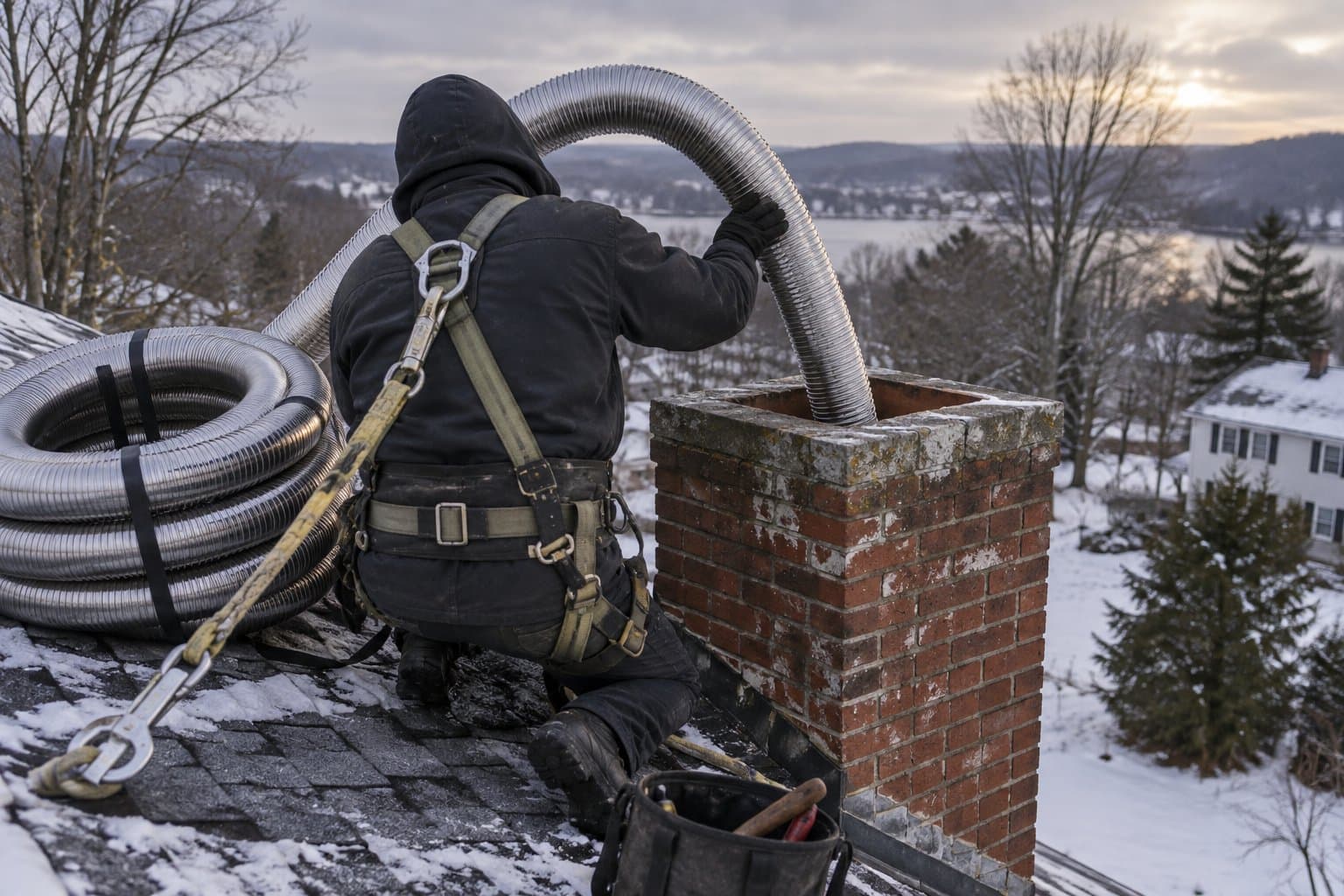
Liners fail for a few ordinary reasons. Clay tiles crack in a chimney fire, so after any chimney fire the flue has to be inspected before it is used again. Heat, age and moisture do the rest. In Freeport that moisture is constant — the village sits on Long Island's South Shore along the back bays, humidity stays high year-round, and salt-laden air rusts metal chimney caps. New York winters bring repeated freeze-thaw cycles that are hard on chimney crowns, mortar joints and brick faces, and they are hardest of all on a flue that has already absorbed water. If the fireplace was converted to gas without relining, acidic condensate attacks the masonry from the inside.
While you wait — please don't
- Stop using the appliance. A damaged liner can let heat and carbon monoxide reach the structure of the house, so the fireplace or stove should stay cold until the flue is verified.
- Get out if anyone feels ill. Headache, nausea, drowsiness or a sounding CO alarm means everyone leaves the house and calls 911 from outside — do not stop to investigate the chimney.
- Don't light it again after a chimney fire. A fire that ran up the flue can crack clay tiles in a way you cannot see from below, and the flue must be inspected before it goes back into service.
- Don't seal or patch the crack yourself. A surface patch does not restore a continuous flue, and the appliance and flue have to be matched for size, material and termination to work safely.
- Don't switch to gas and leave the old flue as is. Converting without relining leaves acidic condensate working on the masonry, which is how an already weak chimney gets worse.
What the technician does
- Camera inspection firstThe technician runs a camera up the flue before anything is quoted, so the condition of the liner is seen rather than guessed at. Ask to watch the footage with them.
- The appliance and flue are matchedThe flue has to suit what it vents — an open fireplace, a wood stove, an insert or a gas appliance all need different sizing. Size, material and termination are checked together.
- Stainless steel liner, sized and insulatedThe usual repair is a stainless steel liner sized to the appliance, insulated where that is required. It gives you one continuous, smooth flue from the appliance to the top.
- Cast-in-place lining where it suitsSome chimneys are better served by a cast-in-place lining, which forms a new flue surface inside the existing masonry. The technician explains which option fits your chimney and why.
- Cap and crown addressed at the same timeWater is what ruins liners, so the crown and the cap are dealt with as part of the job rather than left for later. That matters on a salt-air coast.
- Price before any workThe technician inspects the chimney and gives you the price before anything starts, and you approve it first. Ask for the reasoning in writing.
Why this happens in Freeport, NY
Much of Freeport's housing stock dates from the early-to-mid 20th century — Capes, Colonials, bungalows and split-levels, mostly wood-frame and now re-clad in vinyl or aluminum siding, plus a lot of two-family and multi-family homes. Masonry fireplaces and chimneys here show up mainly in the pre-war houses, which means the flue you are dealing with is often clay tile and often original. Across New York, unlined or clay-tile masonry chimneys needing relining are very common for exactly that reason, while newer construction more often has factory-built metal systems. Many chimneys in older housing are still active venting flues for oil or older atmospheric gas heating, not decorative, so a cracked liner is not something you can simply stop using.
The weather here does the damage twice over. Humid summers keep unused flues damp, which encourages creosote odors and staining; winter freeze-thaw and nor'easter driven rain then work on the crown and mortar. Salt air off the back bays rusts metal chimney caps, and on the canal-front streets off Woodcleft and Guy Lombardo Avenue, where houses sit directly on tidal water, that exposure never lets up. Homes raised or rebuilt after Sandy often have relocated mechanicals, which changes how a flue is run and terminated. Demand across Freeport and nearby Baldwin, Merrick, Rockville Centre and Oceanside climbs in late summer and fall before the heating season, so booking the inspection early is easier than booking it in January.
Questions people ask
- Can I use the fireplace until the liner is replaced?
- No. A damaged liner lets heat and carbon monoxide reach the structure of the house, and the appliance should not be used until the flue is verified. If a CO alarm sounds or anyone feels unwell, get outside and call 911.
- Do I need a permit for relining in Freeport?
- In New York, permits are issued locally by the municipal or county building department, not by a state agency. A permit is typically required for relining a flue as part of an appliance installation and for structural masonry work above the roofline, while routine sweeping and inspection generally do not. Call your local building department before work begins.
- Is there a state chimney license I should ask about?
- New York does not issue a statewide license for chimney sweeping, inspection or masonry repair — it is handled locally. Freeport is in Nassau County, which runs its own home improvement contractor licensing program, so verify current requirements with the county consumer affairs or licensing office.
- We converted the fireplace to gas. Why does the liner matter?
- Converting to gas without relining leaves acidic condensate attacking the masonry from the inside. The flue still has to be matched to the appliance for size, material and termination.
- What codes apply to this work?
- New York enforces the Uniform Fire Prevention and Building Code, based on the International Code Council family of codes with state amendments. Solid-fuel appliance and chimney installations are also commonly evaluated against NFPA 211 and the appliance manufacturer's listed instructions.
- Are you the company doing the work?
- No. One Call Chimney is a referral and scheduling service that arranges chimney work with independent sweeps and masons across all fifty states. We are not the contractor and we do not perform the work.
One call
One call to (866) 576-7943 arranges a chimney technician for your Freeport home, and the estimate is free on every job. The technician inspects the chimney and gives you the price before any work starts, and you approve it first.
More from One Call Chimney
Nearby
Answers
Free tool
Something else in this area
- Damper stuck or broken
- Never been swept
- Water coming in
- Something living up there
- Smells of smoke or damp
- Cracked crown or crumbling brick
- Smoke comes back into the room
- Rebuild or new chimney
One Call Chimney arranges the visit; the technician does the work and gives you the price.